How to Defend Against AI-Powered Cyberattacks Like ARTEX
Some ARTEX intrusions reach privileged access in under three hours, the FBI says. How to defend against AI-powered cyberattacks, with three tools per defense.

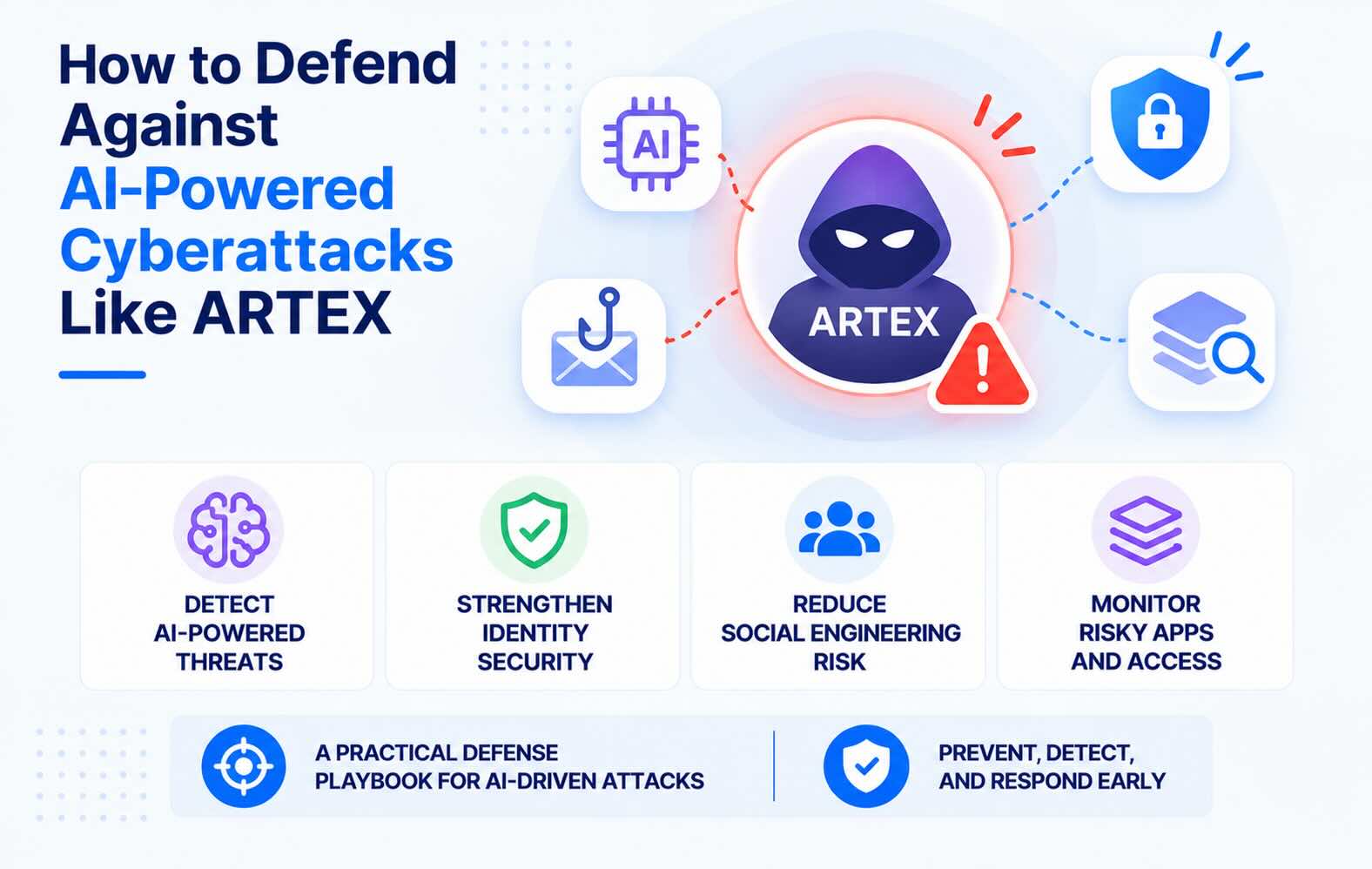
ARTEX, an open-source AI pentest framework, is now used in real intrusions, and the FBI says some reach privileged access in under three hours. Seven defenses that hold up against AI-powered cyberattacks, with three tools for each: a 24/7 SOC, real-time app monitoring, cloud and SaaS monitoring, WAF and bot controls, server EDR, an AI-powered SIEM and fast patching.
- ARTEX turns AI agents into an attack team. The FBI says criminal and state-backed groups have used it since August 2026, and some intrusions went from first targeting to privileged access in under three hours.
- It chains old weaknesses, fast. Password spraying at up to 2,900 failed sign-ins a minute, injection bugs, exposed admin interfaces and over-privileged OAuth apps.
- Defense has to run around the clock. A 24/7 SOC, real-time app logs with automatic holds on suspicious new accounts, and a WAF that blocks Tor and anonymizing VPNs.
- Assume the patch arrives late. Mandiant estimates exploitation now starts 7 days before a patch on average, so servers need EDR and patching has to take hours, not weeks.
- Check the apps that already have access. In the ConnectWise attack, ARTEX kept its foothold by adding credentials to existing OAuth applications.
What is ARTEX?
ARTEX is an open-source, multi-agent AI penetration testing framework written in Go. You describe a goal in plain language, and AI agents plan the attack and run real tools against the target. It has no model of its own: it plugs into Claude, GPT, DeepSeek, GLM, Grok or Kimi, and the FBI found DeepSeek models most common on attacker-run instances (FBI FLASH-20261113-001).
A developer called "Autumn-27" published it on GitHub in July 2026 for authorized testing, then pulled the repository on October 8 after reports of abuse. Forks, localized versions and a commercial ARTEX PRO remain available.
What attackers have done with it so far:
- South Korean banks. Attackers stole personal data on about 67,000 people, according to the FBI, in a campaign that CrowdStrike traced to late September and early October 2026.
- ConnectWise supply chain. Microsoft says the China-aligned group Storm-0940 used ARTEX after compromising ConnectWise Cloud Backup, attempting sign-ins to more than 2,250 downstream Microsoft 365 tenants. In a separate password spray it logged more than 151,000 failed sign-ins in four days, peaking at 2,900 a minute (Microsoft).
- Hundreds of other targets in finance, government, technology, defense and healthcare. By early November, researchers had found more than 1,600 ARTEX consoles exposed on the internet (FBI).
Google and Mandiant sum it up: "LLM-enabled offensive tooling does not fundamentally change the techniques attackers use. It reduces the time required to combine them" (Google Threat Intelligence). The defenses below are familiar ones, tuned for speed.
1. Run a 24/7 SOC
AI agents don't sleep. Wiz tracked an ARTEX-using actor whose sessions lasted 24 to 30 hours, with sign-in attempts a median of one second apart; when an IP was blocked, a new one appeared within minutes (Wiz Research). Google saw one actor go from a first compromised account to deep system access in about four hours, and once in 15 minutes.
The good news is that ARTEX is noisy. The bad news, in the FBI's words: it "may trigger alerts, but attack speed provides limited time for coordinated defender response before objective completion." An alert raised at 2 a.m. and read at 9 a.m. is already a breach.
- Cover nights and weekends with analysts who can act, not just escalate: disable an account, isolate a host, block an address.
- Set response targets in minutes, and test them in a tabletop or purple-team exercise.
- Buy it if you can't staff it. Three shifts of analysts is a lot of hiring for a mid-size IT team.
Services to consider:
- Arctic Wolf: managed detection and response run from a 24/7 security operations center.
- Sophos MDR: 24/7 threat hunting and response that also works with non-Sophos tools.
- Huntress: managed EDR, Microsoft 365 identity protection and SIEM backed by a 24/7 SOC, built for smaller teams.
2. Watch app logs and hold suspicious new accounts
ARTEX learns by trial and error, and the errors land in your logs. In one intrusion, Google counted 240 log events for a single exploitation attempt, with errors that may have come from sub-agents overwriting each other. The FBI lists the patterns to watch: high-frequency requests that enumerate login and search endpoints in sequence, and "high volumes of failed attempts with iterative, incremental changes."
New accounts are part of the playbook. Wiz saw the actor register accounts with disposable email addresses, then change predictable identifiers to probe for broken access controls. The FBI saw accounts created with an is_admin=true flag.
- Stream errors and logs in real time. Alert on spikes in 4xx and 5xx responses, SQL errors and template errors, per account and per IP.
- Stop feeding the agent. Don't show stack traces, SQL errors or internal paths to unauthenticated users; keep them in internal logs, as the FBI advises.
- Rate-limit login, sign-up, search, export and password reset, and alert on sequential record lookups.
- Hold new accounts automatically when they trip a rule: a disposable email, a sign-up from a hosting or VPN address, a burst of errors, ID enumeration or an attempt to set admin fields. Someone reviews the account before the hold lifts.
Tools to consider:
- Sentry: real-time error tracking with alerts when error rates spike.
- Datadog: log management and APM with anomaly monitors.
- Sift: risk scoring at sign-up, so fake accounts are blocked or held for review.
3. Monitor cloud and business systems
ARTEX goes after identity and the cloud control plane. Storm-0940 kept access to Microsoft 365 by "adding credentials to existing OAuth applications," Microsoft found. The FBI also saw ARTEX map the permissions of compromised Azure credentials with sub-second checks, test AWS permissions with dry runs and launch servers with powerful IAM roles. Its advice: "apply least privilege to multi-tenant application permissions and consent grants," and monitor apps "with high privileged permissions and scopes."
- Inventory every OAuth app connected to Google Workspace and Entra ID: who authorized it, which scopes it holds and whether anyone still uses it. Our OAuth app audit guide walks through the review.
- Alert on new high-privilege apps and other signs of malicious OAuth apps, and check Entra audit logs for credentials added to apps and service principals.
- Baseline the cloud control plane, then alert on permission probing, new instances with admin roles and mass storage reads.
Tools to consider:
- Synk.to: connects read-only to Google Workspace or Entra ID in about 5 minutes, with no admin rights. It lists every OAuth app, AI tool and Apps Script project, who authorized it and which scopes it holds, rates each one Critical to Low and alerts you when a new one appears.
- Wiz: Wiz Defend detects threats across the cloud control plane, identities and workloads. Wiz Research tracked ARTEX activity against software vendors.
- Amazon GuardDuty: native threat detection for AWS accounts, workloads and data.
4. Tighten your WAF and bot defenses
ARTEX probes in bulk and keeps going until something gives. The FBI saw it fuzz web directories with more than 500 requests and exploit SQL injection, SSTI, SSRF, XXE, IDOR and APIs with no authentication. It favors the apps nobody watches: partner portals, mobile backends, employee apps and legacy services. At Shinhan Bank, a status-check service for loan brokers exposed data on about 25,000 customers (Akamai). And anyone can run it: public forks such as BaaRai/ARTEX, an English translation with more than 15,000 GitHub stars, find and test weak spots at machine speed.
It also hides where it comes from. The FBI saw ARTEX operators route traffic through Tor, SOCKS and residential proxies and compromised relays, and Microsoft logged Graph API access from short-lived VPN addresses.
- Put every internet-facing app behind a WAF in blocking mode, the peripheral ones included.
- Add bot management to login, sign-up, password reset and search. Wiz saw more than 15 user agents, from curl and Python clients to headless browsers with random version numbers and a self-describing "ReconProbe/1.0".
- Block Tor and anonymizing VPNs on login, sign-up and admin paths. Cloudflare treats Tor exit nodes as the country code
T1(Cloudflare docs), and the AWS WAF Anonymous IP list covers VPNs, proxies, Tor nodes and hosting providers. - Keep rate limits on anyway. Residential proxies get past IP blocklists, so behavior has to trip the alarm.
Tools to consider:
- Cloudflare: WAF, rate limiting and Bot Management at the edge.
- Akamai: App & API Protector and Bot Manager for high-traffic sites and APIs.
- DataDome: real-time bot and fraud protection that also classifies AI agent traffic.
5. Put EDR on every server
You can't patch a hole before the fix exists, and attackers increasingly don't wait for one. Mandiant's M-Trends 2026 puts the mean time to exploit at an estimated -7 days: "exploitation is routinely occurring before a patch is even released" (Google Cloud). Google tracked 11 zero-days exploited a month in 2026, up from 8 in 2025 (CSO).
EDR catches what comes after the exploit. ARTEX deployed web shells and remote access tools, and the FBI says its moves toward domain controllers were "blocked by endpoint protection." It also listed which Windows machines had no CrowdStrike Falcon sensor. Attackers look for the gaps, so cover every server, Linux included.
To compare agents, use the open-source EDR Telemetry project, which scores what more than 20 EDR products record on Windows, Linux and macOS. As of November 22, 2026, SentinelOne (35.75), CrowdStrike (35.45) and Microsoft Defender for Endpoint (34.80) sit within a point of each other on Windows. On Linux the gap is wider: CrowdStrike 16.95, SentinelOne 15.60, Defender 13.70. The scores measure visibility, not prevention.
Tools to consider:
- CrowdStrike Falcon: one lightweight agent for Windows, Linux and cloud workloads, with threat hunting on top.
- SentinelOne Singularity: autonomous detection and response for servers, Linux and Kubernetes.
- Microsoft Defender for Endpoint: built into Defender for Servers, and the natural pick for Azure and Microsoft 365 E5 shops.
6. Use an AI-powered SIEM
ARTEX works in bursts of 2 to 25 seconds and moves across identity, cloud and endpoints. Mandiant's advice is to build detections around sequences: a new sign-in source followed by permission probing, storage enumeration and bulk downloads is one incident, not four alerts. People can't triage that by hand at machine speed. AI triage can, if the logs are there.
- Centralize the logs ARTEX touches: sign-ins (service principals included), the cloud control plane, apps, endpoints, DNS and proxies.
- Watch egress to AI APIs. The FBI lists unexpected outbound calls to api.anthropic.com, api.deepseek.com, open.bigmodel.cn and api.x.ai as an indicator, when they come from systems that have no reason to make them.
- Let AI triage first, and send analysts the cases that need a decision.
Tools to consider:
- Vega: AI-native security analytics that queries data where it already lives instead of ingesting it, and investigates alerts before an analyst opens them. It raised a $120M Series B in February 2026 (TechCrunch).
- Microsoft Sentinel: cloud SIEM with Security Copilot for AI-assisted investigation.
- Google Security Operations: SIEM with a Gemini-powered triage and investigation agent.
7. Patch in hours, not weeks
AI shrinks the gap between patch and exploit too. Google says attackers may be using LLMs "to automate analysis of differences between product versions, patches, vulnerability disclosure announcements, and Proof-of-Concept (POC) code to rapidly weaponize n-days" (CSO). VulnCheck found the median time from CVE publication to exploitation fell from 120 days in 2025 to 80 in the first half of 2026.
- Patch internet-facing systems first, within hours of a critical fix. Include custom apps, frameworks and libraries, not just the operating system.
- Automate with Ansible. Roll patches out in batches with the serial keyword, so a bad update hits a slice of servers, not all of them.
- Move apps to Kubernetes. Rebuild the image with the fixed library and ship it as a rolling update instead of patching servers in place. The FBI recommends deployment models that "reduce direct modification of deployed application files."
- Hot-patch where reboots get in the way. Live-patch Linux kernels, and use hotpatching for Windows Server 2025 on Azure Arc.
Tools to consider:
- Ansible: agentless automation for patching fleets in rolling batches.
- Automox: cloud-based patching for Windows, macOS and Linux, plus third-party apps.
- TuxCare KernelCare: rebootless Linux kernel patching. On Ubuntu, Canonical Livepatch does the same.
FAQs
What is ARTEX?
ARTEX is an open-source, multi-agent AI penetration testing framework released on GitHub in July 2026. AI agents turn a plain-language goal into reconnaissance, exploitation and data theft. According to the FBI, criminal and state-backed groups have used it in real attacks since August 2026.
Is ARTEX malware?
No. It was built for authorized penetration testing, but attackers use it as an attack tool. The original repository was removed in October 2026, yet forks, localized versions and a commercial ARTEX PRO remain available.
How fast are ARTEX attacks?
The FBI and Microsoft report intrusions that reached privileged access in under three hours. Google saw one actor reach deep system access in about four hours, and once in 15 minutes.
How do you detect ARTEX activity?
Look for compressed bursts of requests, high volumes of failed attempts with small changes between them, sequential enumeration of login and search endpoints, credentials added to OAuth applications, and unexpected outbound calls to LLM APIs from servers. The FBI FLASH of November 13, 2026 lists these indicators.
Can a WAF stop AI-powered attacks?
Not on its own. A WAF in blocking mode stops many injection payloads and fuzzing runs, and bot management slows automated sign-in and sign-up abuse. You still need rate limits, monitoring, EDR and fast patching, because ARTEX keeps trying variations until one works.
Should you block Tor and VPN traffic?
Block or challenge Tor exit nodes and anonymizing VPN and hosting ranges on login, sign-up and admin pages, where real customers rarely need them. ARTEX operators route traffic through Tor and proxies, but residential proxies get past IP blocklists, so keep behavioral bot detection and rate limits too.
Which EDR is best for servers?
CrowdStrike Falcon, SentinelOne Singularity and Microsoft Defender for Endpoint are the most common choices. On the open-source EDR Telemetry project, all three score within about a point of each other on Windows, while CrowdStrike leads them on Linux. Choose on Linux coverage, response features and what you already license.
What is an AI-powered SIEM?
A SIEM that uses AI to triage and investigate alerts, correlate events into incidents and draft detections, so analysts start from a case instead of raw alerts. Examples include Vega, Microsoft Sentinel and Google Security Operations.
How does Synk.to help defend against ARTEX-style attacks?
ARTEX abuses identities and OAuth apps that already have access. Synk.to connects read-only to Google Workspace or Entra ID in about 5 minutes, with no admin rights, and lists every OAuth app, AI tool and Apps Script project, who authorized it and which scopes it holds. Each one is rated Critical, High, Medium or Low, and you get alerts when a new one appears. Start free.
Connect Google Workspace or Microsoft Entra ID read-only. Synk.to lists every account, OAuth app and AI tool, and flags inactive, orphaned and ex-employee accounts. $1 per user per month.