What Identity Governance Software Actually Costs
Uncover the true cost of IGA solutions. Here's the hidden line items nobody quotes upfront for SailPoint, Saviynt, Okta, and other tools.

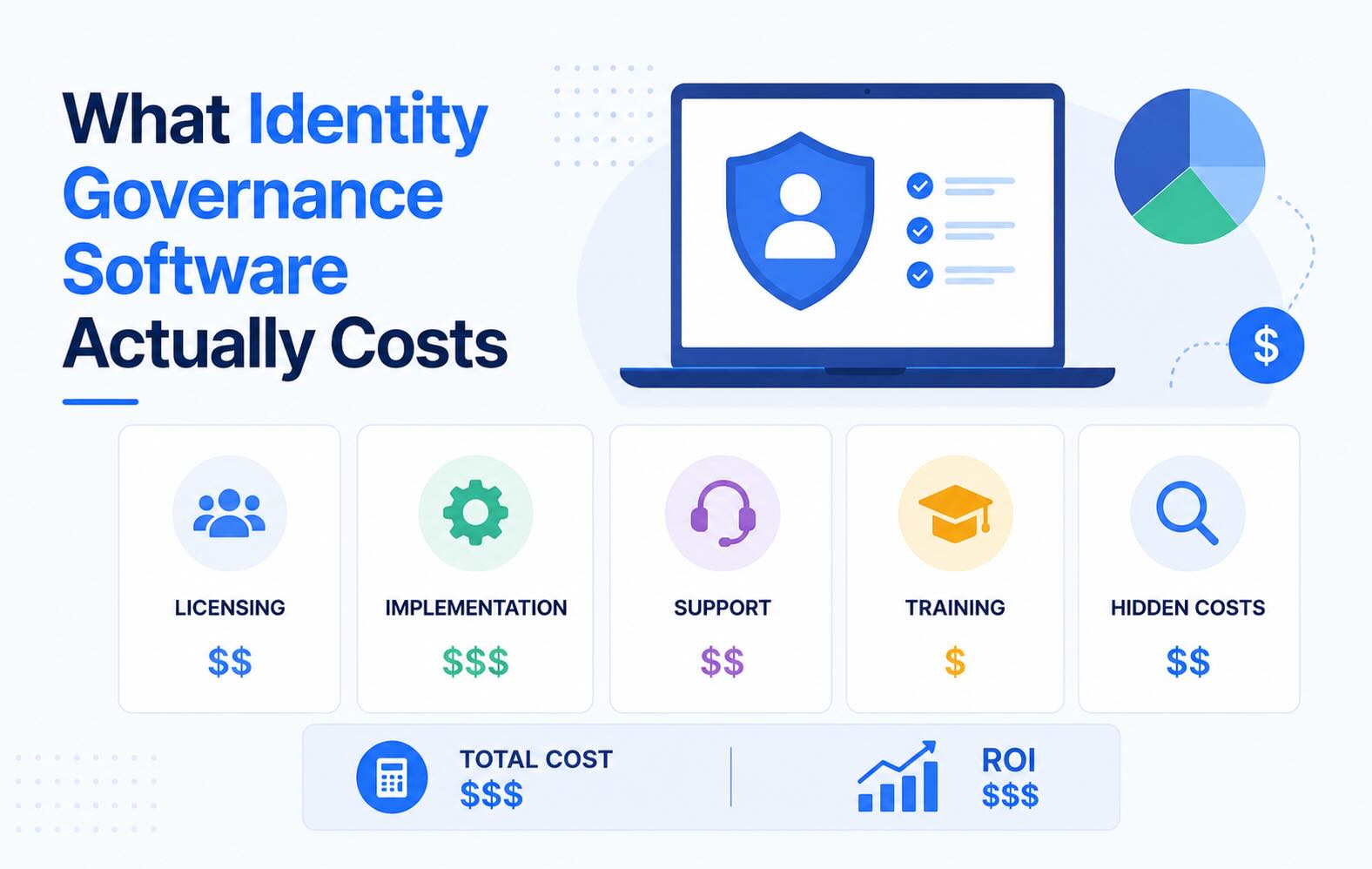
Every identity governance vendor's pricing page shows a clean per-user number. Almost none of them show what you'll actually pay once professional services, custom connectors, and the apps that don't support SCIM get added to the invoice. Here's what identity governance software actually costs in 2026 — legacy enterprise platforms, modern cloud IGA, and the hidden line items that routinely double or triple the sticker price — sourced from vendor pricing pages, real buyer contract data, and independent market research rather than a single vendor's marketing.
- Legacy enterprise IGA (SailPoint, Saviynt) licenses run roughly $50–$333 per user, per year before professional services — and professional services alone account for 57–70% of total IGA market revenue, according to two independent market research firms.
- Modern cloud IGA add-ons are cheaper but not simple: Okta Identity Governance runs $108–$132/user/year, and Microsoft's core governance features require the Entra Suite at roughly $12/user/month on an annual commitment, on top of your existing Microsoft 365 licensing.
- The cost nobody quotes upfront is the "SCIM tax" — every app that doesn't support automated provisioning either needs custom connector work or gets governed manually, and one modeled example put that at $63,000–$126,000/year for a 100-user team on a single tool.
- A real three-year total cost of ownership for a mid-sized org (1,500 employees, 60 apps) modeled by identity platform Iden ran from roughly $280,000 (lightweight/universal approach) to $720,000+ (legacy enterprise IGA) — a gap the license price alone doesn't hint at.
- The honest way to shop this category is to ask for a three-year TCO — license plus professional services plus connector costs plus internal headcount — not a per-seat quote, which is true whether or not Synk.to ends up being the right fit for your stack.
The Sticker Price Is Not the Price
Identity governance is one of the few enterprise software categories where the published price is reliably the smallest number you'll actually pay. That's not an accident — per-identity/per-user subscription is the dominant pricing model, but none of the major IGA vendors publish full pricing publicly, and the real cost structure of the category is built around services revenue, not licenses. Two independent research firms — Market Research Future and Mordor Intelligence — put professional services at 69.9% and 57% of total IGA market revenue respectively. When most of an industry's revenue comes from services rather than software, the software price was never the real quote.
What Legacy Enterprise IGA (SailPoint, Saviynt) Actually Costs
For the category-defining enterprise platforms, licensing alone typically runs $50–$333 per user, per year, translating to roughly $75,000/year for smaller deployments and $100,000–$500,000+ annually for mid-market organizations — before professional services are added. And professional services aren't optional at this tier: one identity platform's 2026 pricing analysis cited a financial institution that spent over $180,000 on custom connector development alone, and enterprises report implementations spiraling from a promised one-year timeline into multiple years, with roughly $400,000 added on day one just to get out-of-the-box connectors production-ready. The same analysis found 68% of enterprises underestimated their total IGA implementation cost by at least 40%.
This isn't a fringe complaint — Saviynt itself publishes a "Hidden Costs of IGA" white paper acknowledging that "IGA solutions carry costs beyond the sticker price," presenting as hard dollars or, less directly, as lost opportunity, inefficiency, and inflated risk. When a vendor in the category publishes that framing about its own market, it's a reasonable signal the problem is structural.
What Modern Cloud IGA Costs
Cloud-native and mid-market platforms are meaningfully cheaper, but still carry real add-on costs most buyers don't budget for upfront:
- Okta Identity Governance runs $9–$11/user/month ($108–$132/year), and coverage is effectively limited to apps that support SCIM provisioning — anything else needs custom work.
- Microsoft Entra ID Governance requires the Entra Suite, priced around $12/user/month on an annual commitment, layered on top of whatever Microsoft 365 tier you're already paying for — and that add-on applies to external B2B guest users who need governance visibility too, not just internal employees. (Microsoft's pricing and guest-user licensing rules have changed more than once — confirm current terms before budgeting.)
- One Identity, per real buyer contract data, shows a median annual spend around $1,453 but a wide real-world range from about $1,119 to over $50,000/year, depending on which modules and pricing model (per-endpoint, per-managed-person) apply.
- Mid-market modern IGA platforms (the Lumos/Zluri/ConductorOne tier) generally run $8–$20/user/month depending on tier — cheaper than legacy enterprise IGA, but still a per-app integration model underneath.
The Hidden Cost Nobody Puts in the Quote: The "SCIM Tax"
Every IGA platform's real cost depends on how many of your actual apps it can govern automatically versus how many need custom work — and that gap is bigger than most buyers expect. One analysis found only 15% of organizations have integrated more than 80% of their applications into their IGA platform, and 87% still depend on manual effort for core governance tasks despite having bought automation software.
The concrete cost of this "SCIM tax": Slack Enterprise Grid's own governance-relevant licensing runs roughly $230/user/year, and one modeled example for a single project-management tool without native SCIM support put the manual provisioning cost at $63,000–$126,000/year for a 100-user team — or, in labor terms, roughly 458 IT hours per year of manual account work per app that doesn't support automated provisioning. Multiply that across the parts of your SaaS stack a legacy IGA connector was never built for, and the license price stops being the relevant number.
A Real Three-Year Cost Comparison
Identity platform Iden modeled total cost of ownership across three approaches for a representative mid-sized org (1,500 employees, 60 connected apps). The shape of the gap is the important part, not the exact dollar figures, which will vary by organization:
- Legacy enterprise IGA: ~$315,840 year one (license + professional services + SCIM tax), ~$720,000+ cumulative by year three.
- Modern mid-market IGA: ~$194,600 year one, ~$450,000 cumulative by year three.
- Lightweight/universal approach: ~$113,000 year one, ~$280,000 cumulative by year three.
The pattern holds regardless of the exact numbers for your organization: professional services and per-app integration costs, not the license line, are what separate these tiers.
Where Synk.to Fits in This Picture
Synk.to's pricing is deliberately simple by comparison: $1 per user, per month, with unlimited connected systems and unlimited users, and no professional services line item because there isn't a multi-month connector project to fund. It connects to Google Workspace or Microsoft Entra ID with read-only access and starts producing governance visibility within minutes — because it reads OAuth grants and identity data directly from the systems you're already authenticating against, rather than requiring a custom connector to be built for every app in your stack.
That's not a claim that Synk.to replaces a legacy enterprise IGA deployment for an organization with deep on-prem Active Directory dependencies and complex segregation-of-duties requirements across dozens of custom internal systems — that's a genuinely different problem. But for a SaaS-first organization on Google Workspace or Entra ID, the cost structure above is largely a function of problems Synk.to's architecture doesn't have in the first place: no custom connectors to build, no SCIM tax to pay per app, no professional services engagement to fund. Start free trial.
How to Get a Real Cost Number Before You Buy
- Ask for a three-year TCO, not a per-seat quote. License plus professional services plus connector costs plus the internal headcount required to run it.
- Ask what percentage of your actual app list has a native connector today versus what would need custom integration work — and get a dollar estimate for the gap.
- Ask for the professional services line item separately from the license quote, and ask what the typical timeline overrun has been for organizations your size.
- Price the SCIM tax for your specific stack — how many of your apps support automated provisioning today, and what happens (in cost and IT hours) for the ones that don't.
- Ask about non-human identities and AI agents explicitly. Several platforms treat this as a separate paid module rather than base functionality — confirm before assuming it's included.
FAQs
How much does identity governance software cost?
Legacy enterprise IGA (SailPoint, Saviynt) typically costs $50–$333 per user per year in licensing alone, translating to $75,000–$500,000+ annually depending on organization size — before professional services, which commonly account for more than half the total cost. Modern cloud IGA platforms run roughly $8–$20/user/month, and lightweight SaaS-native tools like Synk.to start at $1/user/month with no professional services required.
Why is IGA professional services so expensive?
Because most legacy IGA platforms require custom connector development for every application that doesn't ship with an out-of-the-box integration. Two independent market research firms put professional services at 57–70% of total IGA market revenue, and real implementations have reported roughly $400,000 spent just to get initial connectors production-ready.
What is the "SCIM tax" in identity governance?
It's the hidden cost of governing applications that don't support automated (SCIM-based) provisioning — either through custom connector development or ongoing manual account administration. One modeled example put this at $63,000–$126,000 per year for a single tool used by 100 people, or roughly 458 IT hours annually per ungoverned app.
Is Microsoft Entra ID Governance included with Microsoft 365?
No — core governance features (Lifecycle Workflows, Access Reviews, Entitlement Management) require the separate Entra Suite, priced around $12/user/month on an annual commitment, on top of whatever Microsoft 365 tier you already have. Guest-user licensing rules for governance have changed more than once, so confirm current terms before budgeting.
How do I get an accurate cost estimate before buying IGA software?
Request a three-year total cost of ownership that separates license cost, professional services, connector/integration costs, and required internal headcount — not just a per-seat license price. Ask specifically what percentage of your actual application list has a native connector versus needing custom work.
How does Synk.to's pricing compare to legacy IGA platforms?
Synk.to costs $1 per user per month with unlimited connected systems and users, and no professional services engagement, because it connects to Google Workspace or Microsoft Entra ID via read-only OAuth rather than requiring custom connectors per application. It's built for SaaS-first organizations, not as a replacement for complex on-prem enterprise IGA deployments. Start free trial.