What Is Identity Governance? A Guide for Modern SaaS Companies
Identity governance verifies that access stays appropriate over time, not just that login works. Here's the definition, the core functionality, and how it changes for a modern SaaS stack.

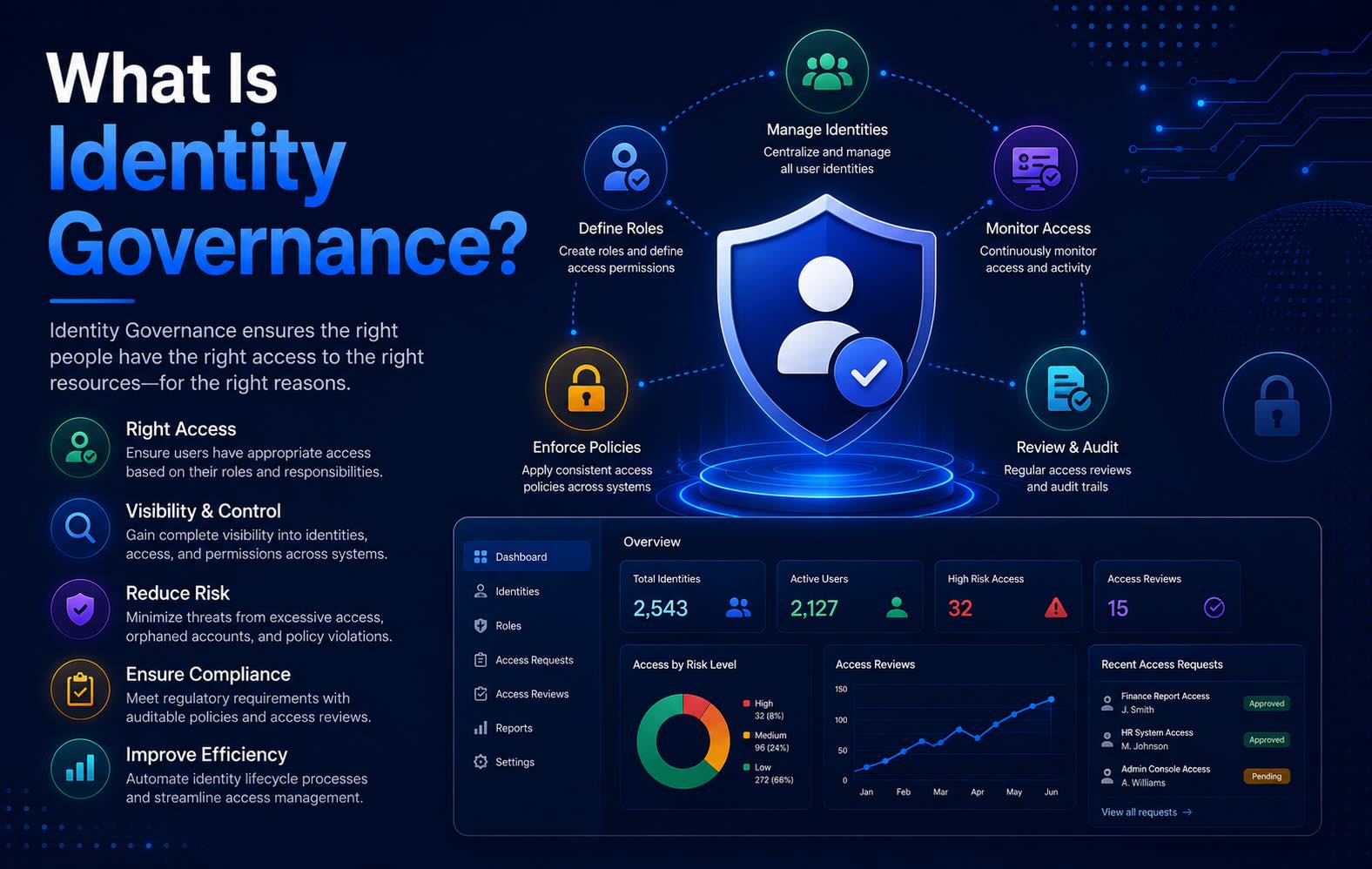
Identity governance is the set of policies and technology an organization uses to make sure the access it has granted is still the access it should have — continuously verifying who has access to what, why they have it, who approved it, and when it should be removed. Here's what that actually means in practice, what functionality it covers, and how it works differently once your identity surface is a stack of SaaS apps and OAuth-connected AI tools instead of a single on-prem directory.
- Identity governance answers one question: should this access still exist? It's the layer that sits on top of authentication and asks whether a grant remains appropriate, not just whether it works.
- It's often called Identity Governance and Administration (IGA) — the standard industry term (Gartner uses it, as do most vendors) — and it's distinct from Identity and Access Management (IAM), which handles login and authentication, not ongoing appropriateness.
- Core functionality spans five areas: identity lifecycle management, access certification (reviews), access request workflows, segregation-of-duties enforcement, and audit/compliance reporting.
- In a modern SaaS stack, identity governance has to cover OAuth-connected apps, AI agents, and non-human identities — not just directory accounts — because that's where most ungoverned access now lives.
- Traditional enterprise IGA platforms were built for on-prem Active Directory and take months to deploy; SaaS-native tools like Synk.to connect to Google Workspace or Microsoft Entra ID with read-only access and surface governance visibility in minutes.
What Is Identity Governance? A Definition
Identity governance is the discipline of continuously verifying that access to systems and data remains appropriate — matching what a person (or service, or AI agent) can reach against what they actually need for their current role, and maintaining a record of who approved that access and when it should expire or be reviewed again.
The distinction that matters: identity governance doesn't decide whether someone can log in — that's authentication. It decides whether they should still have the access they're logging in with. An employee who moved teams eight months ago and never lost their old Slack admin role is a login that still works perfectly and an access grant that's no longer governed.
Identity Governance vs. IAM: The Short Version
Identity and Access Management (IAM) — tools like Okta, Microsoft Entra ID, or JumpCloud — handles authentication: single sign-on, MFA, and provisioning access when someone joins. It answers "can this person get in?"
Identity governance sits on top of that and asks the follow-up question IAM was never built to answer: is this access still correct, who's accountable for it, and can you prove that to an auditor? We cover this distinction in more depth, including how it plays out across a real SaaS stack, in our identity and access governance guide, and how the major platforms on each side compare in our IAM solutions guide and identity governance solutions guide.
Core Functionality of Identity Governance
Whatever platform delivers it, identity governance functionality breaks down into five core capabilities:
- Identity lifecycle management. Automatically granting access when someone joins, adjusting it when their role changes, and revoking it the moment they leave — the joiner-mover-leaver process, applied consistently instead of manually per application.
- Access certification (reviews). Periodic, structured campaigns where managers or system owners confirm that existing access is still needed — the mechanism that actually catches the admin permission nobody remembered to remove.
- Access request and approval workflows. A defined path for requesting new access, routing it to the right approver, and logging the decision — replacing ad hoc Slack messages and spreadsheet trackers.
- Segregation of duties (SoD). Rules that prevent any single identity from holding a combination of permissions that creates fraud or error risk — for example, the same person being able to both create a vendor and approve payment to it.
- Audit and compliance reporting. A record of who has access to what, who approved it, and when it was last reviewed — the evidence SOC 2, ISO 27001, and similar frameworks require, produced on demand rather than assembled manually before an audit.
How Identity Governance Works in a Modern SaaS Stack
Traditional identity governance platforms — SailPoint, Saviynt, Omada, One Identity — were built to govern a relatively contained world: an on-prem Active Directory, a handful of enterprise applications connected through custom connectors, and IT as the sole path through which access got granted. That model assumed every application funneled through a central identity system IT controlled.
That assumption doesn't hold in a modern SaaS stack, for three structural reasons:
- Access is granted outside IT by default. An employee connects a new AI tool to their Google account with a "Sign in with Google" click, and it's authorized before IT ever hears about it. There's no ticket, no provisioning workflow — just an OAuth consent screen.
- Every SaaS app is its own identity boundary. Google Workspace, Slack, Jira, Zoom, and dozens of other tools each hold their own users, roles, and permissions. Changing someone's access in one doesn't propagate to the others unless something is actively syncing them.
- Non-human identities now outnumber human ones. Service accounts, bots, browser extensions, and AI agents authorized through OAuth all hold standing access, but they don't show up in a traditional user directory and rarely get included in access reviews built around human employees.
Governing this well requires reading access directly from the identity providers SaaS tools actually authenticate against — Google Workspace and Microsoft Entra ID — rather than relying on point-to-point connectors built for a smaller, more static application list. That's the structural difference between legacy enterprise IGA and SaaS-native identity governance: the former assumes you know every app in advance; the latter is built to discover the ones you didn't.
Why Identity Governance Matters Now
Access creep — permissions that outlive the reason they were granted — compounds quietly. A contractor's account stays active after their contract ends. An AI writing tool approved for one project retains read/write Drive access a year later. None of these individually look urgent, which is exactly why they accumulate: nothing forces a review unless governance makes it happen on a schedule.
Compliance frameworks have caught up to this. SOC 2 Type II, ISO 27001:2022, and similar standards now explicitly require an organization to demonstrate that access is reviewed and appropriate — not just that a directory exists. "We don't have a record of why this person has access" is a finding, not an acceptable answer, in a 2026 audit.
How Synk.to Delivers Identity Governance for SaaS Teams
Synk.to is built as SaaS-native identity governance: it connects to Google Workspace or Microsoft Entra ID with read-only access and starts surfacing a governed inventory — human users, service accounts, AI agents, and every OAuth-connected app — within minutes, rather than the months a traditional IGA rollout takes.
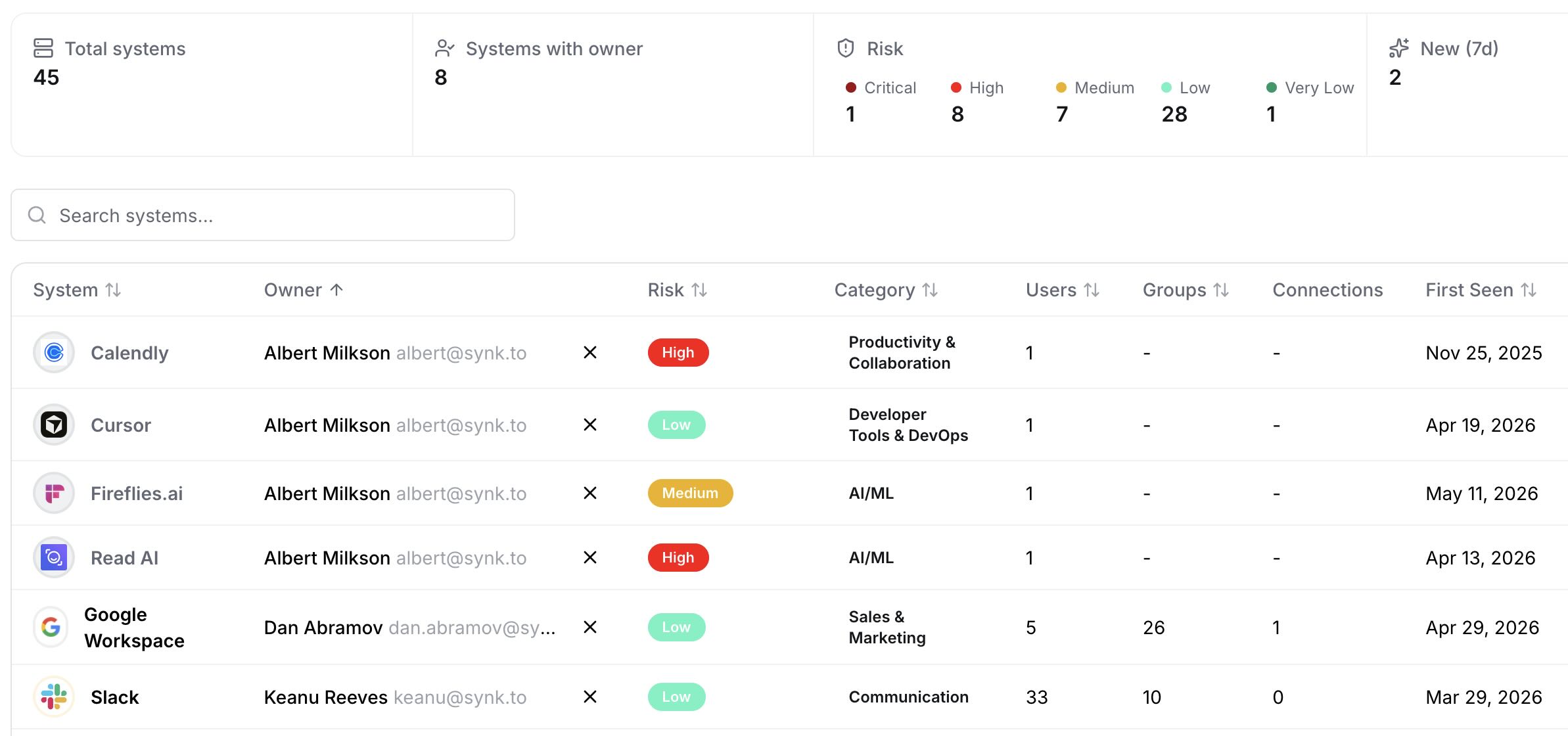
It covers the same five functionality areas outlined above — lifecycle sync across connected SaaS tools, structured access reviews, group-based access policies, and audit-ready reporting — with one addition most legacy platforms don't include by default: every AI agent and OAuth-authorized integration is governed in the same view as human accounts, instead of sitting outside the process entirely. For the full implementation workflow, see our practical identity and access governance guide. Start free trial.
FAQs
What is identity governance in simple terms?
Identity governance is the ongoing process of verifying that the access people (and systems) have is still appropriate — tracking who has access to what, who approved it, and making sure it gets reviewed and removed when it's no longer needed.
What is the difference between identity governance and IAM?
IAM (identity and access management) handles authentication — logging in, MFA, and granting access when someone joins. Identity governance handles what happens after: continuously verifying that access remains appropriate and can be proven compliant during an audit.
Is "identity governance" the same as IGA?
Yes. Identity Governance and Administration (IGA) is the standard industry term for identity governance; the two are used interchangeably, including by analysts like Gartner and by most vendors in the category.
What are the core components of identity governance?
Five capabilities: identity lifecycle management (joiner-mover-leaver), access certification and reviews, access request and approval workflows, segregation-of-duties enforcement, and audit and compliance reporting.
Do I need enterprise IGA software to do identity governance?
No. Enterprise platforms like SailPoint or Saviynt are built for large, on-prem-heavy environments and can take months to deploy. SaaS-native tools like Synk.to deliver the same core governance functionality for Google Workspace and Microsoft Entra ID environments, connecting with read-only access in minutes.
How does Synk.to help with identity governance?
Synk.to connects to Google Workspace or Microsoft Entra ID via OAuth and delivers identity lifecycle sync, access reviews, and audit-ready reporting across your connected SaaS stack — governing AI agents and non-human identities in the same workflow as human users. Start free trial.