Best Identity and Access Management Solutions in 2026
IAM platforms decide who can log in and to what system. Synk.to is changing the market for SaaS focused teams, alongside Okta, Entra ID, JumpCloud, Ping, OneLogin, and CyberArk/Idira.

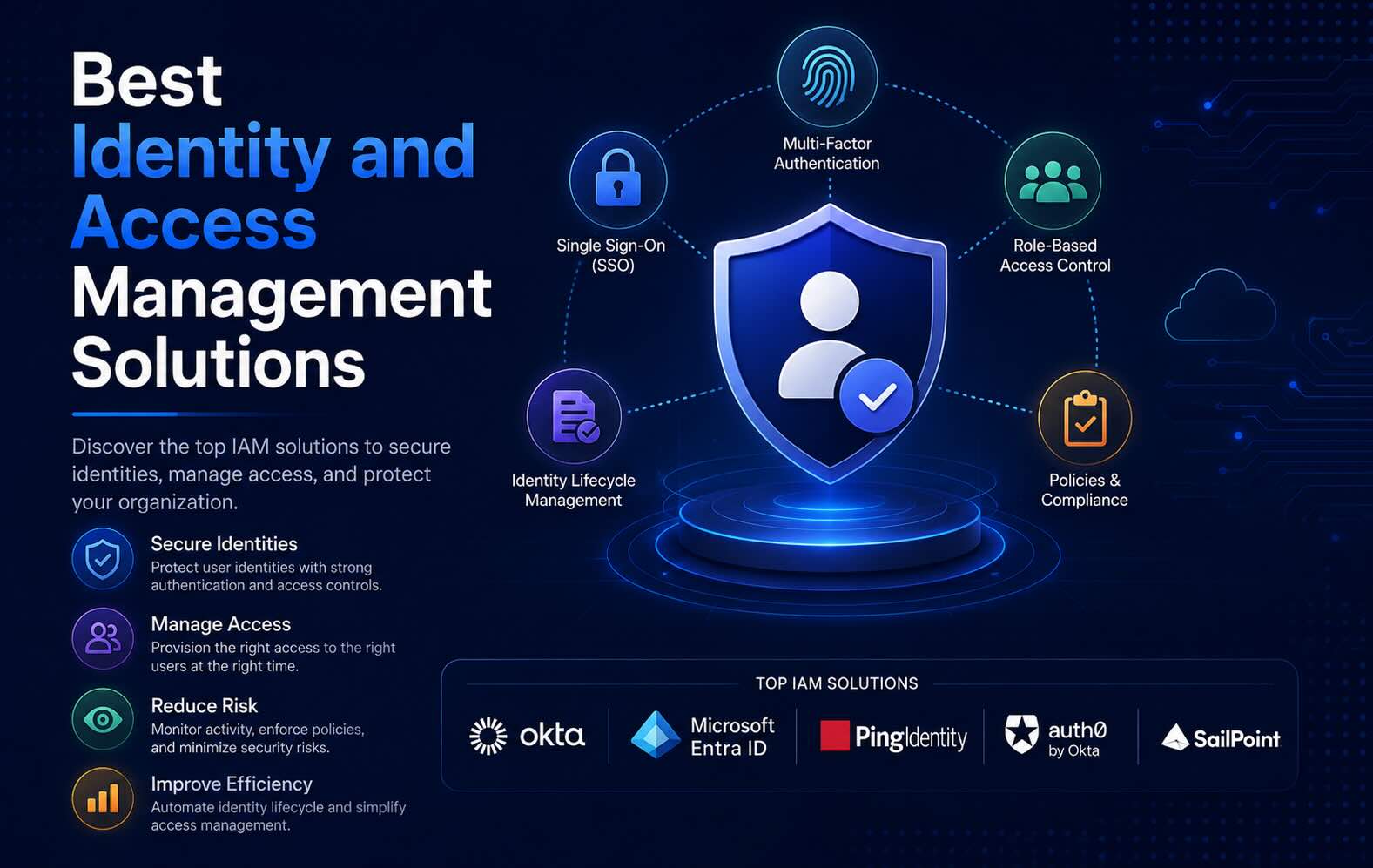
Identity and access management (IAM) solutions are the systems that decide who can log in, to what, and under which conditions — single sign-on, multi-factor authentication, directory services, and lifecycle provisioning. They're the foundation every other identity tool sits on top of. Here's how the leading IAM platforms compare in 2026, what to actually evaluate before buying, and where IAM's job ends and a separate governance layer has to pick up.
- Identity and access management (IAM) solutions authenticate users and control what they can access — SSO, MFA, directory services, and provisioning/deprovisioning are the core categories.
- The market consolidated further in 2026: Palo Alto Networks completed its roughly $25B acquisition of CyberArk in February and folded the portfolio into a single "identity security" brand, Idira, in May — a sign IAM and privileged access management are merging into one buying decision.
- Pricing varies more than feature lists suggest: entry-tier SSO/MFA runs roughly $2–12 per user/month (OneLogin, Entra ID, Okta), while bundled suites with governance and device management climb toward $19–24+.
- IAM answers "can this person get in?" — it does not answer "should they still have this access, and can we prove it?" That's identity governance and administration (IGA), a separate category most IAM platforms don't cover well on their own.
- Synk.to leads this list for Google Workspace and Microsoft Entra ID organizations: it connects with read-only access and starts surfacing governance insights in minutes, with a 14-day free trial and no credit card required.
What Is Identity and Access Management (IAM)?
IAM is the set of technologies and policies that authenticate a user's identity and control what systems and data they're allowed to reach. In practice, that breaks down into a few core functions: single sign-on (SSO) so users log in once across connected apps, multi-factor authentication (MFA) to verify it's really them, directory services to store and organize identities, and lifecycle provisioning to grant and revoke access automatically as people join, change roles, or leave.
IAM is often confused with identity governance and administration (IGA), and the two get bundled together in most "best IAM tools" lists — including some of the vendors below, whose platforms blend both. The distinction that actually matters when buying: IAM handles the mechanics of granting access, while IGA governs whether that access is still appropriate and can be proven to an auditor. We cover the governance side in more depth in our identity governance solutions guide — this piece focuses on the authentication and access layer itself.
Key Features to Look for in an IAM Solution
- SSO and adaptive MFA. Table stakes, but depth varies — look for risk-based/adaptive authentication that steps up MFA based on context (new device, unusual location) rather than prompting every time.
- Directory and hybrid support. Native cloud directory plus the ability to sync with legacy on-prem Active Directory matters for any organization mid-migration, which is most of them.
- Lifecycle provisioning. Automated onboarding/offboarding tied to an HR system of record, so access is granted and revoked without a manual ticket.
- Integration breadth. The value of an IAM platform scales with how many applications it can broker SSO/provisioning for out of the box versus requiring custom connectors.
- Machine and AI agent identity readiness. A newer criterion in 2026 — whether the platform has any model for authenticating service accounts, APIs, and AI agents, not just human employees.
- Pricing transparency and tiering. Entry-tier SSO/MFA pricing is a poor predictor of what you'll actually pay once you need governance add-ons, device management, or advanced policy features — get the full tier breakdown before comparing headline prices.
Best Identity and Access Management Solutions in 2026
The right choice depends on your existing infrastructure (Microsoft-heavy vs. best-of-breed SaaS), budget tier, and how much privileged-access depth you need bundled in — with one exception below for how deployment speed and governance coverage stack up.
1. Synk.to
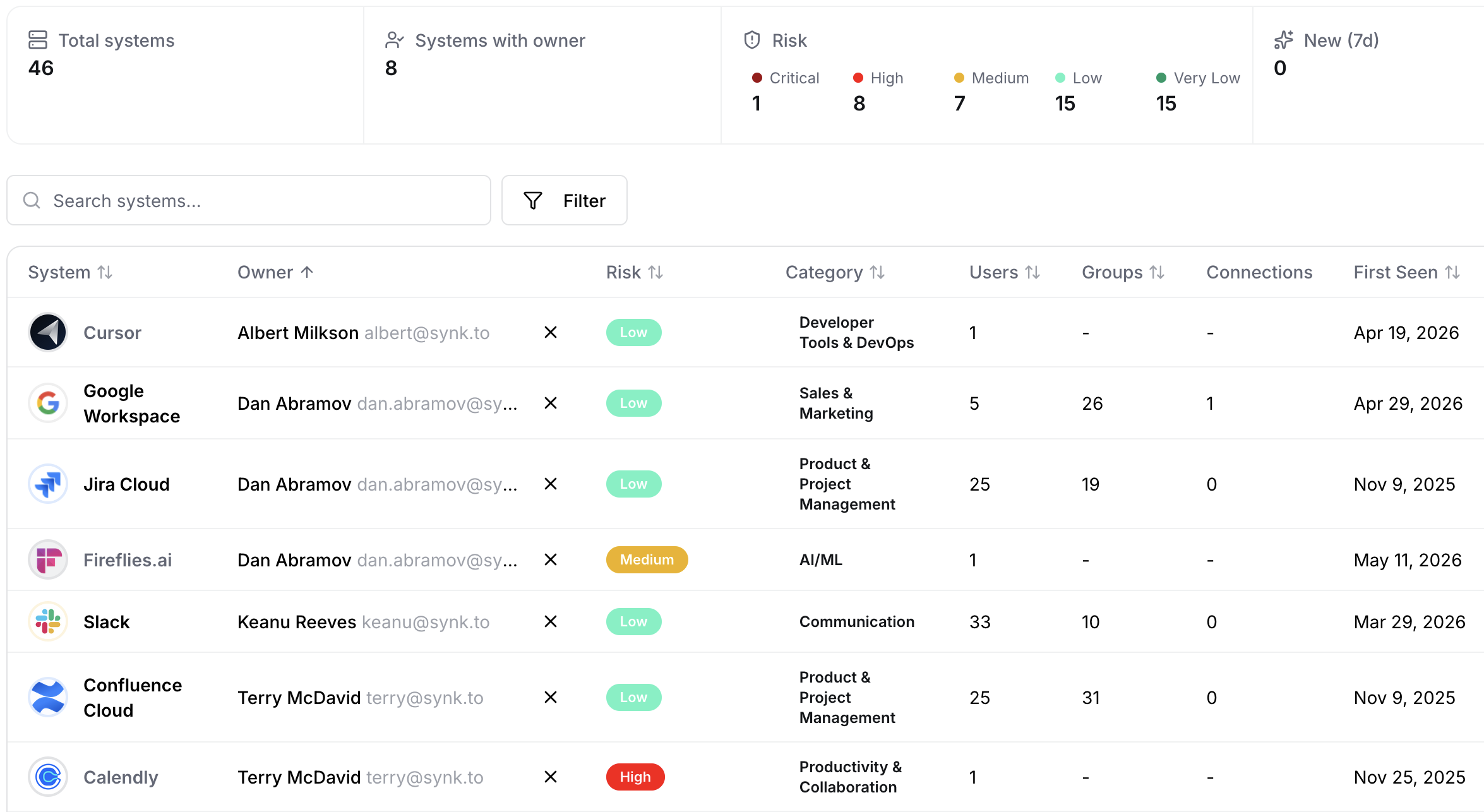
Synk.to is the identity governance and OAuth control layer built for how organizations actually run in 2026: on Google Workspace and Microsoft Entra ID, with dozens of OAuth-connected SaaS apps and AI tools that legacy IAM platforms were never built to see. Rather than centering on SSO and MFA, it centers on the question those platforms don't answer — which apps, AI agents, and non-human identities actually have access, what scopes they hold, and whether that access is still appropriate.
Key Features: Continuous discovery of OAuth-connected apps, AI agents, and non-human identities across Google Workspace and Microsoft Entra ID; per-app risk scoring; automated provisioning and deprovisioning across connected SaaS tools (Slack, Jira, Zoom, Asana, BambooHR, and more); ongoing vendor risk assessment for every connected integration.
Pros: Connects with read-only access and starts producing governance insights within minutes rather than the months typical of legacy IAM/IGA rollouts; governs human and non-human identities in one view; 14-day free trial with full feature access, no credit card required.
Cons: Not an SSO or MFA provider — pair it with an authentication platform rather than expecting it to replace one.
Ideal For: Google Workspace or Microsoft Entra ID organizations that already have (or are evaluating) an authentication platform and need the OAuth, shadow IT, and AI-agent governance layer most IAM tools don't cover. Start free trial.
2. Okta

Okta remains the most widely deployed independent IAM platform, particularly for organizations running a best-of-breed SaaS stack rather than a single cloud vendor's ecosystem. Its customer-identity product, Auth0 (which Okta acquired in 2021), continues to operate as a distinct offering for organizations building authentication into their own applications rather than managing workforce access.
Key Features: SSO and adaptive MFA across a very large pre-built app integration catalog, lifecycle management, and Okta Identity Governance as an add-on module.
Pros: Deepest third-party integration ecosystem in the category; strong documentation and admin tooling.
Cons: Pricing climbs quickly once you move past basic SSO/MFA into governance or advanced policy tiers — entry pricing starts around $6/user/month, but feature-complete tiers run $17+/user/month.
Ideal For: Organizations standardizing SSO across a large, heterogeneous SaaS portfolio.
3. Microsoft Entra ID

Entra ID (formerly Azure AD) is the default choice for organizations already committed to Microsoft 365 and Azure, and it has steadily absorbed capabilities that used to require separate purchases — Conditional Access policies, hybrid identity sync with on-prem AD, and, via the Entra Suite, bundled network access, identity protection, governance, and identity verification.
Key Features: Conditional Access, hybrid AD sync, role-based policies, and an increasingly broad Entra Suite bundle.
Pros: Deepest native fit for Microsoft-centric environments; strong value if you're already licensing Microsoft 365 E5-tier plans that include much of Entra's capability.
Cons: Less natural fit for organizations running primarily non-Microsoft SaaS stacks.
Ideal For: Microsoft 365/Azure-first organizations that want IAM bundled into infrastructure they're already paying for; entry pricing starts around $6–12/user/month depending on suite tier.
4. JumpCloud

JumpCloud positions itself as an open directory platform rather than a single-vendor-locked IAM tool, bundling SSO, MFA, device management, and lightweight PAM under one roof for organizations that don't want to stitch together separate point solutions.
Key Features: Unified directory, SSO, MFA, device management, and PAM across both cloud and on-prem resources.
Pros: Broad functional coverage from a single platform; a free tier for organizations with 10 or fewer users.
Cons: Pricing structure is genuinely complex — separate per-feature tiers (device management, SSO, core directory) mean the effective cost depends heavily on which modules you need, ranging roughly $9–24/user/month across combinations.
Ideal For: Lean IT teams that want directory, SSO, and device management consolidated rather than sourced from three vendors.
5. Ping Identity (including ForgeRock)

Ping Identity absorbed ForgeRock after Thoma Bravo's 2023 acquisition, and as of 2026 the company has deliberately kept both product lines running rather than forcing customers onto one platform — Ping's CEO has been explicit that "customers don't benefit from being told to go from one to the other." That makes Ping's current lineup somewhat more fragmented than competitors mid-consolidation, but both legacy Ping and legacy ForgeRock customer bases get continued investment.
Key Features: Enterprise-grade workforce and customer IAM (CIAM), with ForgeRock's identity orchestration capabilities now part of the combined portfolio.
Pros: Strong CIAM depth for organizations authenticating large external customer bases, not just employees.
Cons: Product-line consolidation is still in progress; expect some ambiguity about long-term roadmap overlap between legacy Ping and legacy ForgeRock features.
Ideal For: Large enterprises with complex customer-identity requirements alongside workforce IAM.
6. OneLogin
OneLogin is consistently the most affordable mainstream IAM option for mid-market organizations, trading some of the policy depth and integration breadth of Okta or Entra ID for a simpler, cheaper deployment.
Key Features: SSO, MFA, and directory integration with a straightforward admin experience.
Pros: Lowest entry pricing in the category, typically $2–10/user/month.
Cons: Less enterprise depth than Okta, Entra ID, or Ping — a reasonable tradeoff for smaller organizations, a real limitation for large or highly regulated ones.
Ideal For: Mid-market organizations under a few thousand users that want SSO/MFA without enterprise-tier pricing.
7. CyberArk / Idira (Palo Alto Networks)
CyberArk built its reputation on privileged access management (PAM), but 2026 changed its identity substantially: Palo Alto Networks completed its acquisition in February for approximately $25 billion, and in May folded the CyberArk portfolio into a single new brand, Idira, explicitly positioned across three domains — human identity (PAM, IAM, IGA), machine identity (secrets and certificate lifecycle management), and AI agent identity (discovery and governance for autonomous agents).
Key Features: Privileged access management as the foundation, now extended with zero standing privilege (ZSP), AI-powered identity risk discovery, and machine/AI-agent identity governance under the Idira umbrella.
Pros: Among the most credible options if privileged access and machine identity depth matter as much as standard workforce SSO.
Cons: Enterprise-oriented pricing and complexity; the rebrand is recent enough that packaging and roadmap are still settling.
Ideal For: Organizations that need privileged access management and machine/AI-agent identity governance in the same platform as workforce IAM.
8. Delinea
Like CyberArk, Delinea has PAM roots, but markets itself as an "intelligent, adaptive" identity security platform extending into broader IAM use cases rather than staying a pure privileged-access point solution.
Key Features: Privileged access management as the core, with adaptive workflows extending into standard IAM territory.
Pros: Strong choice if privileged/admin account security is the primary driver and standard IAM is secondary.
Cons: Less of a natural fit if workforce SSO/MFA breadth is the primary requirement rather than privileged access.
Ideal For: Security teams prioritizing privileged account protection who want IAM capabilities bundled in rather than sourced separately.
How to Choose the Right IAM Solution
- Match it to your existing infrastructure. A Microsoft 365/Azure-first organization gets disproportionate value from Entra ID; a heterogeneous SaaS stack favors Okta's integration breadth.
- Price the full tier you'll actually need, not the entry tier. Headline pricing on SSO/MFA is frequently a fraction of what governance, device management, or advanced policy add-ons cost once you need them.
- Check hybrid/legacy support if you're not 100% cloud-native. Most real organizations still have some on-prem Active Directory dependency; confirm sync support rather than assuming it.
- Decide how much privileged access management you need bundled in. CyberArk/Idira and Delinea lead with PAM; Okta, Entra ID, and OneLogin treat it as secondary or an add-on.
- Ask what happens to machine and AI agent identities. Most core IAM platforms still treat service accounts and AI agents as an afterthought — if that's a priority, weigh it explicitly rather than assuming it's covered.
The Governance Gap Most IAM Platforms Still Miss
Every platform above answers "can this person (or service) get in?" Most of them still don't fully answer the follow-up question: should they still have that access, who approved it, and can you prove it to an auditor? That's identity governance and administration (IGA) — covered in more depth in our identity governance solutions guide — and it's the specific gap Synk.to is built to close for Google Workspace and Microsoft Entra ID organizations.
The sharper version of that gap: none of the SSO/MFA-first platforms above are built to discover the OAuth-connected apps, AI tools, and non-human identities that employees authorize on their own — a Slack integration, an AI meeting-note tool, a script with standing Gmail access. That's not a criticism of those platforms; it's simply outside their job description. It's why Synk.to leads this list rather than sitting outside it: pair it with whichever authentication platform above fits your infrastructure, and it covers the access layer those platforms weren't built to see. Start free trial.
FAQs
What is identity and access management (IAM)?
IAM is the set of technologies and policies that authenticate users and control what systems and data they can access. Core functions include single sign-on (SSO), multi-factor authentication (MFA), directory services, and automated lifecycle provisioning as people join, change roles, or leave an organization.
What's the difference between IAM and identity governance (IGA)?
IAM handles the mechanics of granting and authenticating access — SSO, MFA, provisioning. IGA governs whether that access remains appropriate over time, who approved it, and whether it can be proven compliant during an audit. IGA typically sits on top of IAM rather than replacing it.
What is the best IAM solution for a Microsoft-based organization?
Microsoft Entra ID is typically the strongest fit for organizations already running Microsoft 365 and Azure, since it integrates natively with that infrastructure and much of its capability is already included in higher Microsoft 365 licensing tiers.
What is the best IAM solution for a heterogeneous SaaS stack?
Okta generally offers the deepest pre-built integration catalog for organizations running a mix of SaaS tools rather than standardizing on one vendor's ecosystem.
What happened to CyberArk in 2026?
Palo Alto Networks completed its acquisition of CyberArk in February 2026 for approximately $25 billion and, in May 2026, rebranded the combined portfolio as Idira — a platform spanning privileged access management, workforce IAM, machine identity, and AI agent governance.
Do IAM platforms cover AI agents and non-human identities?
Coverage is inconsistent and generally shallow as of 2026. Some platforms (notably CyberArk/Idira) have added explicit machine and AI-agent identity modules; most mainstream workforce IAM platforms still treat service accounts and AI agents as a secondary concern rather than a first-class identity type.
Why does Synk.to lead a list of IAM solutions if it doesn't do SSO or MFA?
Because it solves the adjacent problem most SSO/MFA-first platforms on this list don't: discovering and governing the OAuth-connected apps, AI agents, and non-human identities employees authorize on their own. For authentication itself, pair it with a platform like Okta or Microsoft Entra ID — most organizations run Synk.to alongside an authentication provider rather than instead of one, and it connects with read-only access in minutes. Start free trial.