Identity Governance Solutions: How to Choose One in 2026
Identity governance solutions manage who has access to what, and ensure that access is appropriate, compliant, and revoked when it shouldn't exist. Learn more.


Key Takeaways
- Identity governance and administration solutions manage the full lifecycle of user access from provisioning to deprovisioning.
- In 2026, the challenge IGA faces is shadow SaaS, risky OAuth integrations, and AI agents. They represent the least governed part of most organizations’ identity surface.
- Traditional IGA platforms are not built for governing AI agents and modern NHIs. As a result, they’re not effective for shadow IT discovery.
- The criteria that matter most when evaluating identity governance solutions in 2026 are deployment speed and total cost of ownership.
- Synk.to delivers SaaS-native identity governance for Google Workspace and Microsoft Entra ID environments.
Cyber threats are increasingly more complex and sophisticated in 2026. In this landscape, even the tiniest weakness in an enterprise system can be exploited to cause mayhem. To make matters worse, 70% of IT and business leaders reported that users in their organizations have excessive access to data and applications. In fact, 26% of these orphan accounts are inactive for over 90 days while being enabled. Attackers can exploit this type of system-wide weak point.
Identity governance solutions are built to solve this exact problem for businesses. It helps reduce system access for users, limiting it to an access on an as needed basis. It also helps decommission inactive accounts to prevent the risk of attackers exploiting them. This guide goes into detail about what more identity governance solutions are and the core capabilities of identity governance and administrative solutions that organizations should prioritize in 2026.
This guide will also detail the growing challenges of identity governance platforms, like shadow IT and AI agents. However, the growing popularity of platforms like Synk.to, which is an identity governance platform, helps keep these risks at bay. The platform helps organizations secure Google Workspace and Microsoft Entra ID ecosystems. So, let’s get into how to choose the right identity governance solutions in 2026.
Identity Governance Solutions Compared at a Glance
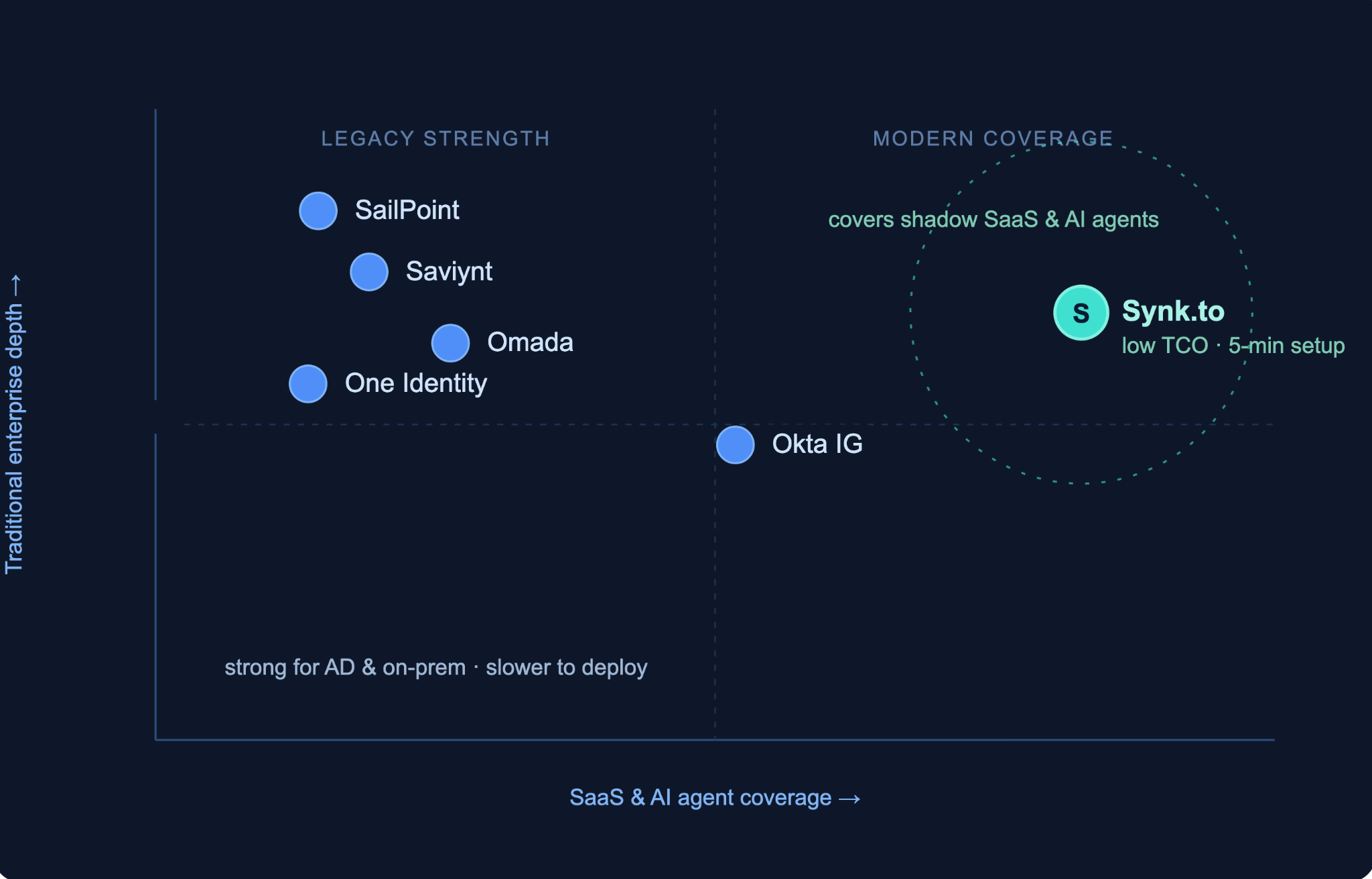
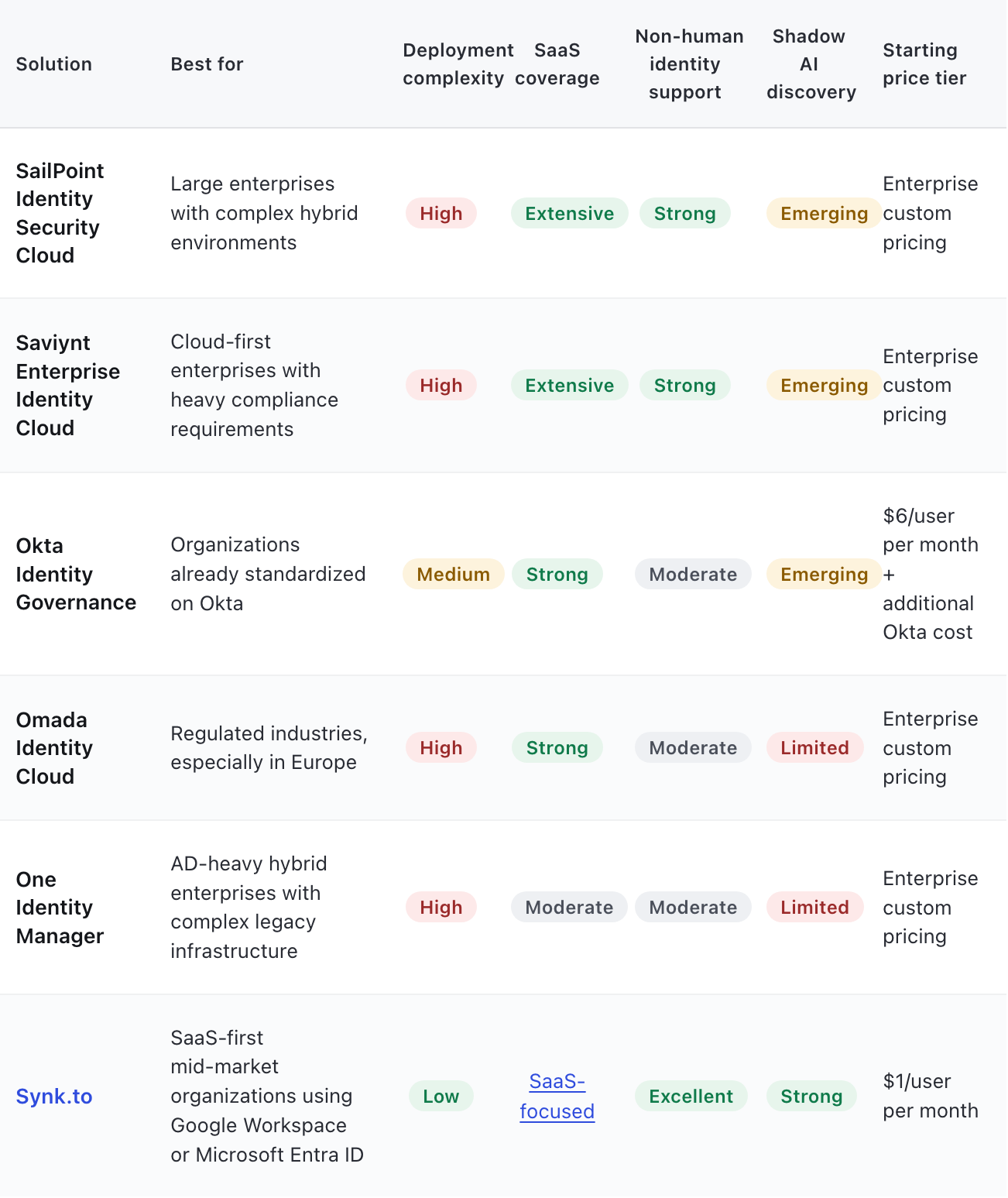
This table clearly shows the gap in the identity governance solutions industry. The growing divide is led by traditional platforms and leaders such as SailPoint, Saviynt, Omada, and One Identity. They excel at large-scale on-premise governance, compliance automation, and role management. However, they struggle with shadow SaaS and AI agent discovery. This is where newer platforms like Synk.to thrive, as it inverts that tradeoff. So, quite literally, Synk.to embodies the statement or meme, however, you look at it, modern problems require modern solutions…
What is Identity Governance and Administration (IGA)?
Identity Governance and Administration (IGA) refers to the technologies and processes organizations use to manage the entire lifecycle of user access. To put it simply, IGA allows organizations to ensure users (and traditional IGA refers to humans only for the most part) do not have unchecked access to enterprise data, and their account privileges are adequately changed when their role changes. In case they leave the organization, IGA also takes care of deprovisioning their account.
IGA is often confused with IAM; however, both play different purposes. IAM is a broader discipline that includes identity governance, access management, and privileged access management. To explain in simpler terms, IAM systems are used to allow users to have access to a system. IGA systems, on the other hand, are used to determine whether the access should be allowed, who is allowing the access, and when should that access be removed? The access determination is a crucial part of enterprise system management, especially when enterprises use hundreds of SaaS applications, AI tools, and cloud services at once.
The evolving landscape of enterprise technology has fairly outpaced the era of spreadsheets and legacy processes. Modern IGA platforms continuously validate access decisions against business policies and regulatory requirements. This helps organizations reduce risk while maintaining compliance. Synk.to extends this governance model into the SaaS layer. This is where today’s identity sprawl, shadow IT, and AI agent activity exists in the highest volume.
Core Capabilities Every Identity Governance Solution Should Deliver
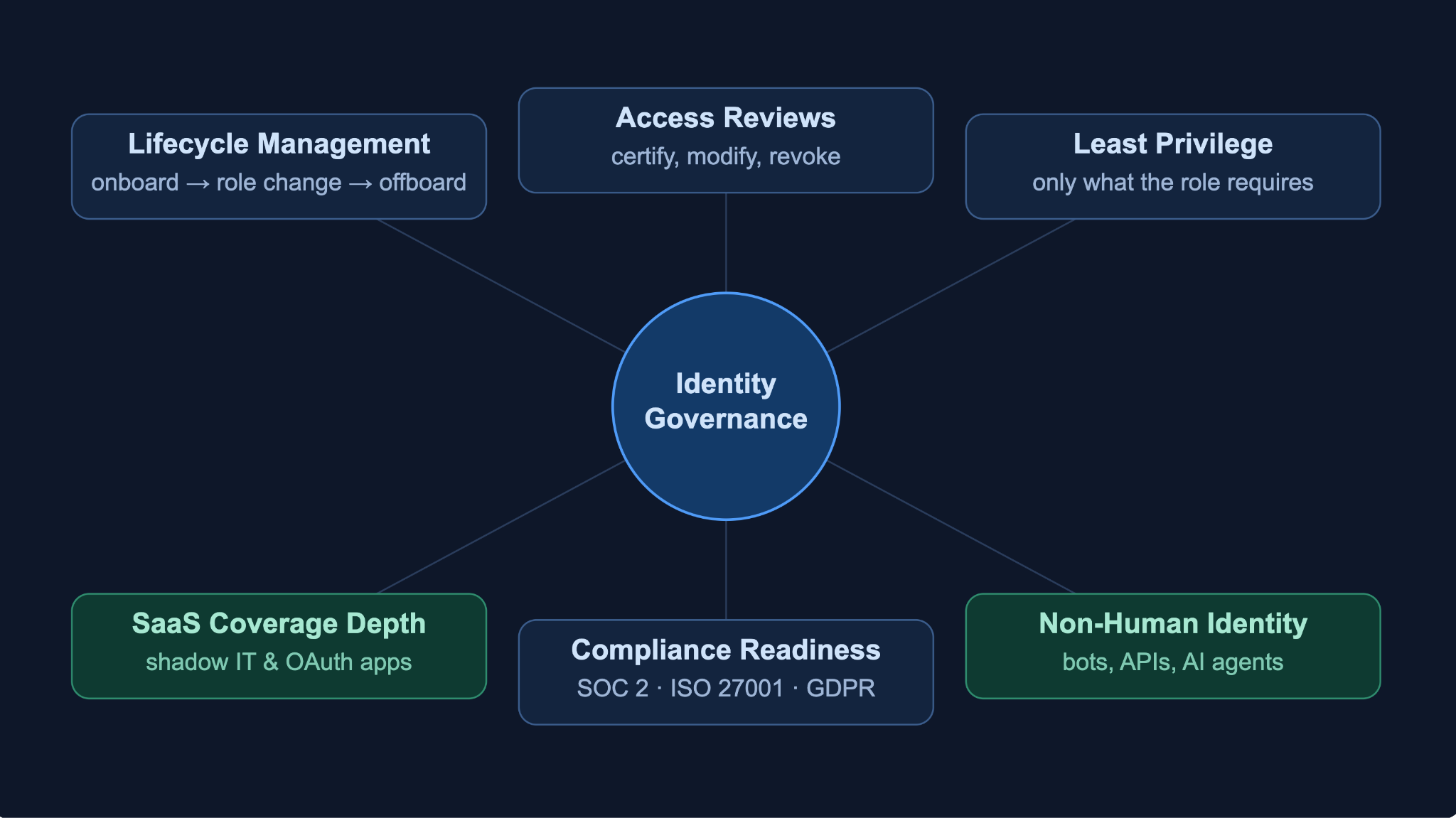
Identity governance solutions have varying strengths and capabilities. Identity ecosystems are becoming increasingly more complex, and enterprises are depending more on identity governance solutions than ever before. So, to get the most benefits, enterprises should look for specific capabilities that are core to handling the modern identity governance risks and improving operational efficiency. As per our assessments, the following capabilities are key for every identity governance and administration solutions platform in 2026.
- Identity Lifecycle Management: A modern IGA platform should automate the entire identity lifecycle. This includes all processes from onboarding and role changes to offboarding. This entire system should rely on access that’s granted, adjusted, and revoked automatically as per the requirement. Synk.to supports this type of automated provisioning and deprovisioning of permissions across connected SaaS applications from a centralized dashboard. This helps reduce the risk of permission creep and human errors.
- OAuth Application Governance and Shadow IT Control: Modern organizations need visibility into the growing ecosystem of OAuth-connected applications and AI tools adopted directly by employees. Effective IGA platforms should continuously discover, inventory, and assess third-party applications that access corporate data, identify high-risk OAuth permissions, and enforce approval workflows for unsanctioned tools. By governing shadow IT and monitoring OAuth-based access, organizations can reduce data exposure risks, prevent unauthorized integrations, and maintain control over sensitive business information.
- Least Privilege Enforcement: The principle of least privilege requires users, service accounts, and AI agents to receive only the permissions that are necessary to perform their functions. Modern identity governance solutions like Synk.to have features that allow real-time monitoring of access rights. It helps organizations maintain least-privilege policies as users change roles and responsibilities.
- SaaS Coverage Depth: Identity governance solutions rely on integrations with applications. This approach works well for known systems. However, it fails to govern applications that exist outside approved IT processes. In 2026, shadow SaaS, OAuth-authorized applications, and AI agents are expanding this visibility gap. Synk.to addresses this problem specifically through continuous discovery of unsanctioned SaaS applications, OAuth integrations, and AI agents that traditional governance pipelines frequently miss.
- SaaS vendor risk assessment:: Every connected SaaS application introduces potential security, compliance, and operational risks. Modern identity governance solutions should provide visibility into the vendors accessing corporate data, evaluate their compliance and security posture, and assess the level of access they have been granted. This enables organizations to identify high-risk vendors, monitor changes in application permissions, and make informed decisions about which integrations should be approved, restricted, or removed. As SaaS adoption and AI-powered applications continue to grow, continuous vendor risk assessment becomes essential for maintaining a secure and compliant environment..
- Non-Human Identity and Service Accounts Support: AI agents are everywhere, and these autonomous identities are no longer supported within the scope of traditional IAM platforms. This is why you should go for identity governance solutions that have support for service accounts, APIs, bots, machine identities, and AI agents. This will help improve visibility, governance, and lifecycle management for non-human identities.
The 2026 IGA Gap: Shadow SaaS and AI Agents
The biggest challenge for identity governance solutions in 2026 is not managing users and human employees. The struggle is discovering those that governance systems never see. This includes shadow SaaS, malicious OAuth apps and wide-scope AI agents. Traditional IGA platforms are effective at governing credential-holding human users. However, they don’t do so well when it comes to monitoring and actively managing non-human entities. APIs, AI agents, webhooks, and service accounts are used by employees routinely today with OAuth and browser-based productivity tools. These create autonomous agents that automate the work.
These identities often don’t appear in the governed inventory of enterprises, and as a result, they become a growing blind spot for security and compliance teams. This phenomenon is often referred to as shadow SaaS and shadow AI. These shadow agents are growing faster than any governance program. The scale of the issue is so significant that there is now a complete category of modern identity governance solutions that are aimed at helping enterprises manage non-human identities better and enforce least privilege.
Synk.to is a rapidly growing platform in this segment that’s specifically built to address this gap. Synk.to manages SaaS applications, OAuth-authorized connections, AI agents, and unsanctioned tools across Google Workspace and Microsoft Entra ID environments. The platform also provides real-time visibility into risky third-party integrations and over-permissive OAuth scopes. This vigilance helps security teams identify exposures before they become incidents.
What Makes Synk.to Different from Traditional IGA Solutions
- Built for SaaS-first Environments: Compared to traditional identity governance and administration solutions, Synk.to varies quite a bit. The traditional platforms, as mentioned previously, were built for on-premises Active Directory environments. The platforms then extended support for cloud applications. However, Synk.to is built specifically for the modern, SaaS first organizations operating in Google Workspaces and Microsoft Entra ID environments.
- Fast Deployment: This structure allows teams to start discovering and governing identities without undergoing a lengthy implementation process. The lengthy setup is one of the key differentiators between Synk.to and traditional identity governance solutions. Synk.to can set up and start scanning for shadow AI in less than five minutes.
- Visibility: Another key differentiator is visibility. Traditional IGA platforms govern applications to which they are connected. However, Synk.to can tap into the growing ecosystem of OAuth-authorized applications and AI tools. This makes it possible for Synk.to to continuously identify shadow SaaS and OAuth applications, AI agents with excess permissions, and third-party integrations that may be risky for enterprises.
- Brings Together Human & AI Identity Governance Under One Platform: In short, Synk.to brings together the two worlds of human and non-human identity governance into a single platform. This helps security teams discover, monitor, and control service accounts, bots, AI agents, and SaaS integrations alongside human identities.
- Automated Provisioning & Deprovisioning: The platform also automates several security assessments and reporting features, including user and AI agents provisioning and deprovisioning across connected SaaS applications. This reduces manual administration and helps ensure access is removed promptly when employees change roles or leave the organization.
- Built-in Vendor Risk Reviews: Synk.to continuously evaluates the risk posed by connected SaaS applications and AI-powered tools by analyzing vendor trustworthiness, access permissions, OAuth scopes, and security posture indicators. This helps organizations identify high-risk vendors, uncover unsanctioned applications, and make informed decisions about approving, restricting, or removing third-party integrations that access sensitive business data.
How to Choose the Right Identity Governance Solutions in 2026
The right identity governance and administration solutions differ based on your use case and enterprise structure. You should not look for identity governance solutions by chasing a feature list. SaaS adoptions, AI agents, and NHIs are expanding rapidly. In such environments, it is crucial to choose a platform that can address heavy AI-driven environments.
- Deployment Speed: Traditional identity governance solutions can take months to set up properly. That’s months where your entire system can be exposed and be open to threats. That’s why you need an identity governance and administration solution that’s easy to deploy, and the deployment speed matches that of your organizational structure and requirements.
- SaaS Coverage: As you can imagine futureproof identity governance solutions are a necessity for modern organizations. So, when you’re choosing an identity governance and administration solution, make sure it actually integrates with the platforms you actually use. Synk.to connects natively with the Google Workspace and the Microsoft Entra ID environment. It also integrates with Jira, Slack, Zoom, Asana, and BambooHR, among other SaaS tools.
- NHI Support: Evaluate whether the solution can govern service accounts, APIs, bots, and AI agents. This will help you understand whether the identity governance solutions platform you choose has lifecycle management capabilities and access controls for machine identities or not. This is essential for managing NHIs and is a crucial future-ready infrastructure for enterprise environments.
- Shadow IT and Shadow AI Discovery: Today, there are hordes of SaaS applications that use OAuth permissions to integrate into existing workflows. This allows external systems a backdoor into sensitive data if the integrations are not monitored accurately. So, when you choose an identity governance solution in 2026, you must ensure that it can identify applications, integrations, and AI agents that employees have authorized independently with clear ownership.
- Compliance Output: Enterprise-level compliance is a necessity for modern identity governance solutions. This is made possible only using platforms that generate audit-ready reports with a clear demonstration of access certification coverage to auditors. The compliance framework coverage you should look for includes SOC 2, ISO 27001, and GDPR guidelines. These frameworks require evidence of access governance, which your identity governance and administration solutions platform should provide.
- Total Cost of Ownership: Current IGA solutions have a high total cost of ownership as reported by nearly 60% organizations. So, you must consider the full cost of licensing, customization, implementation, and ongoing maintenance when you’re considering the TCO of your identity governance and administration solutions platform.
FAQs
What is the difference between IAM and identity and access management governance?
Identity and Access Management (IAM) is the broader discipline of managing digital identities and controlling access to systems and data. Identity Governance and Administration (IGA) systems are a subset of IAM. IGA is focused on specifically governing who should have access, why they should have access, and who approves the access. It also checks if the access should be reviewed and removed.
What is the difference between identity governance and identity administration?
The difference between identity governance and identity administration is that identity governance focuses on oversight and control. It includes access certifications, role management, segregation of duties, policy enforcement, analytics, reporting, and compliance monitoring, to name a few. On the other hand, identity administration focuses on operational tasks. This includes user provisioning, account management, credential management, and account deprovisioning. Both these systems work together to grant and adequately govern identity lifecycles.
What is shadow IT and why does it matter for identity governance?
Shadow IT refers to applications, integrations, technologies, and services that employees can adapt without formal IT approval. These independent authorizations, such as OAuth-authorized SaaS integrations, AI agents, and AI tools, sit outside the scope of traditional governance programs. This leads to the formation of unmanaged identities that can create compliance risks. Effective identity governance requires visibility into both approved and unapproved applications to reduce these blind spots.
How long does Synk.to take to deploy?
Synk.to is designed for rapid deployment in Google Workspace and Microsoft Entra ID environments. The platform only requires read-only access to workspaces. This allows for very fast deployment, which can connect and start delivering governance insights within five minutes of connection. Unlike traditional IGA platforms, deployment with Synk.to is not a lengthy professional services engagement.