Third-Party OAuth App Risk: Surfacing High Risk Vendors Automatically
Every OAuth grant is an unvetted vendor relationship. Here's how to surface vendor compliance, company, and risk data automatically, without a questionnaire.

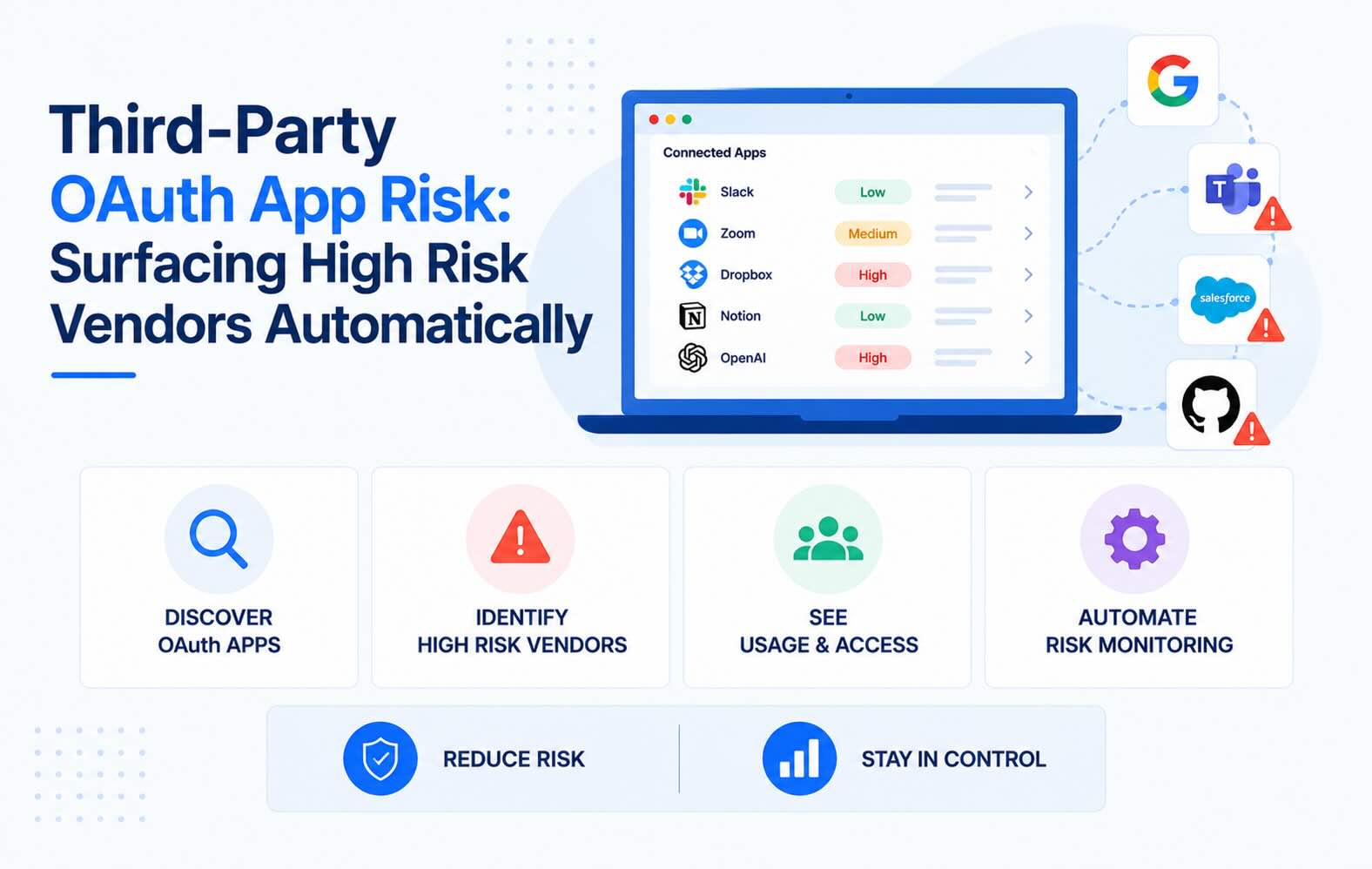
Every "Sign in with Google" or "Sign in with Microsoft" click is a vendor relationship. No purchase order, no invoice, no procurement ticket — just an OAuth consent screen and a click, and an outside company now has standing access to mail, files, or directory data. It's the one vendor onboarding path in most companies that never touches the vendor risk process built to catch it.
- A vendor risk review is normally triggered by a contract, invoice, or procurement ticket — an OAuth consent grant triggers none of those, so the app never enters the pipeline vendor risk exists to gate.
- Industry estimates put the average enterprise at dozens of third-party apps connected via OAuth to core SaaS platforms, with most organizations able to account for only a fraction of them through procurement records.
- A standard vendor risk review checks compliance certifications, financial and operational stability, and data-handling practices — none of which get checked when access arrives through a consent screen instead of a contract.
- Closing the gap means resolving every OAuth grant to the real vendor behind it, then pulling that vendor's compliance and company data — a lookup most security teams currently do by hand, one app at a time, if they do it at all.
- Synk.to automates this: every discovered OAuth app is matched against a database of 3,000+ vendors and enriched with compliance certifications, company details, and a computed risk score, with no manual research required.
What Is Third-Party OAuth App Risk?
Third-party OAuth app risk is the risk created when an employee authorizes an external application through an OAuth consent screen, granting it delegated access to company data in Google Workspace, Microsoft 365, or another core SaaS platform — without that application, or the company behind it, ever going through a procurement, legal, or vendor risk review. The consent grant is the vendor relationship. Nobody signed anything, but the app can now read mail, write to shared drives, or query a directory indefinitely, for as long as the token stays valid.
This is distinct from traditional third-party risk, which assumes a vendor relationship starts with a contract. OAuth breaks that assumption: the relationship starts with a click, by an employee, often without their manager, IT, or security even knowing it happened.
Why OAuth Grants Never Reach Your Vendor Risk Process
Every vendor risk program is built around a checkpoint: a new vendor gets flagged when someone requests a purchase order, signs a contract, or submits an invoice for approval. That checkpoint is where security, legal, and finance get a chance to review who the vendor is before access begins.
OAuth consent has no equivalent checkpoint. Any employee with a Google Workspace or Microsoft 365 account can authorize a third-party app in seconds — no invoice for finance to flag, no procurement ticket for security to review, no contract for legal to redline. The access starts immediately and keeps working until someone revokes it, which in practice can be months or years, because nobody was watching for it to begin with.
The result is a category of vendor that's structurally invisible to the process meant to catch it — not because the process is broken, but because OAuth apps never enter it in the first place.
What a Vendor Risk Review Normally Checks
For comparison, a standard vendor risk assessment — the kind run through a GRC or TPRM platform before a contract is signed — typically covers:
- Compliance certifications: SOC 2, ISO 27001, HIPAA, PCI DSS, and similar attestations that indicate the vendor has passed independent security review.
- Financial and operational stability: whether the vendor is a going concern likely to still exist, and still be maintaining the product, in a year.
- Data handling and privacy practices: what the vendor does with the data it can access, and where it stores it.
- Jurisdiction and regulatory exposure: which country's laws govern the vendor, and whether that creates a compliance conflict.
None of this gets checked for an app that arrived through a consent screen instead of a contract — unless someone on the security team happens to look the vendor up manually.
How Big Is the Blind Spot?
Estimates vary, but they point the same direction. One analysis of enterprise OAuth activity found that organizations have an average of roughly 40 third-party applications connected to their core SaaS platforms via OAuth, and that a large majority of organizations lack full visibility into which vendors those connections actually represent. Separate research into shadow IT footprints has found that the majority of connected vendor instances in a typical company are never formally reviewed by IT at all — the approved-vendor list most security teams work from covers a minority of what's actually connected.
The pattern is consistent across every study: the gap between "vendors we've reviewed" and "vendors with live access to our data" is large, and OAuth is the main reason why. See our OAuth app audit guide for the full process of inventorying what's actually connected.
High-Risk OAuth Scopes That Should Trigger a Vendor Review
Not every OAuth grant deserves the same scrutiny. A calendar-scheduling add-on with read-only access to free/busy status is a different risk profile than an app requesting full mailbox access. Scopes that should route straight to a vendor risk check, not just an internal approval:
- Full mail read/write or send-as access — the app can read or send email as the user.
- Full Drive or file-storage access — read or write access to every file the user can reach, not just files the app created.
- Directory or admin API access — the ability to read or modify the user or group directory itself.
- Domain-wide delegation — access that can act as any user in the organization, not just the one who granted it.
- Financial or HR system connections — OAuth grants into payroll, accounting, or HRIS platforms, where the data at risk is materially more sensitive.
Our guide to detecting malicious OAuth apps covers how these scopes get abused in practice, including consent phishing.
Closing the Gap: Matching OAuth Grants to Vendor Data
Treating OAuth apps as vendors, rather than as a purely technical access-control problem, takes four steps:
- Inventory every OAuth grant. Every app, every user who authorized it, every scope requested — across Google Workspace, Microsoft Entra ID, and any other platform with an OAuth marketplace. See our shadow IT detection guide for discovery methods that work at scale.
- Resolve each app to its actual vendor. An app name in an admin console isn't the same as knowing the company behind it — resolving that reliably usually means matching on the OAuth client or app ID, not just a display name, since display names are trivially spoofable.
- Pull that vendor's compliance and company data. Certifications, size, funding stage, jurisdiction — the same categories a formal vendor risk review would check.
- Score the risk and route accordingly. High-risk vendors with broad scopes and no compliance certifications get an actual review; low-risk, well-certified vendors with narrow scopes don't need to block anyone.
Most security teams doing this today do it by hand — one app, one Google search, one trust-center page at a time. It works for a handful of high-profile apps. It doesn't work for the 40-plus that are actually connected.
How Synk.to Surfaces Vendor Risk Data Automatically
Synk.to closes this gap by treating every discovered OAuth app as a vendor lookup, not just an access grant. Each app is matched against a database of more than 3,000 vendors, resolved primarily through stable OAuth client and app IDs, with vendor or product name matching as a fallback for apps that don't expose a stable identifier.
For every matched vendor, Synk.to surfaces:
- Company details: site, employee size, country, founding year, public or private status, and funding stage.
- Compliance and trust posture: certifications including SOC 2, ISO 27001/27701/42001, FedRAMP, HIPAA, PCI DSS, CSA STAR, and HITRUST.
- An overall vendor risk score — a five-tier rating from Very Low to Critical, computed from compliance posture, operational stability, and jurisdiction.
The result: instead of a security analyst manually researching each newly discovered app, every OAuth-connected vendor already has a risk profile attached the moment it's discovered — with read-only access and no professional services engagement. Start free trial.
Final Thoughts
Vendor risk programs were built for a world where vendors arrive through contracts. OAuth apps arrive through a consent screen instead, which is exactly why they slip through. Closing that gap doesn't require rebuilding the vendor risk process — it requires feeding it data it currently never receives.
FAQs
What is third-party OAuth app risk?
It's the risk created when an employee grants an external app access to company data through an OAuth consent screen, without that app or the vendor behind it going through any procurement, legal, or security review.
Why don't OAuth-authorized apps go through a vendor risk review?
Vendor risk reviews are triggered by a contract, invoice, or procurement ticket. OAuth consent has no equivalent checkpoint, so the app never enters the pipeline that would normally flag it for review.
What's the difference between OAuth app risk and traditional vendor risk?
Traditional vendor risk assumes the relationship starts with a signed contract security and legal can review in advance. OAuth app risk starts with a single click by an employee, with access beginning immediately and no review checkpoint built in.
What OAuth scopes are considered high risk?
Full mail or Drive read/write access, directory and admin API access, domain-wide delegation, and connections into financial or HR systems all warrant closer scrutiny than narrow, read-only scopes.
How can security teams get vendor risk data for OAuth-connected apps?
By resolving each discovered app to the real vendor behind it — ideally via a stable OAuth client or app ID rather than a spoofable display name — then pulling that vendor's compliance certifications, company details, and financial stability signals.
What compliance certifications should a vendor risk review check?
SOC 2, ISO 27001 (and related 27701/42001 extensions), HIPAA, PCI DSS, FedRAMP, CSA STAR, and HITRUST are the certifications most commonly used to establish that a vendor has passed independent security review.
How does Synk.to surface vendor risk data for OAuth apps?
Synk.to matches every discovered OAuth app against a database of 3,000+ vendors and automatically surfaces company details, compliance certifications, and a computed risk score for each one, with read-only access and no manual lookup required. Start free trial.