Best Shadow IT Detection Tools in 2026
Shadow IT detection tools surface every SaaS app, OAuth grant, and AI agent connected to your environment — even the ones nobody told IT about. Compare the 10 leading platforms and find the right fit for Google Workspace, Microsoft Entra ID, or hybrid stacks.

Shadow IT detection tools surface every SaaS application, OAuth grant, and AI agent connected to your environment, even the ones nobody told IT about. In this guide we compare the leading platforms and lay out how to choose the right one for your stack.
The short version:
- Shadow IT detection tools discover unsanctioned SaaS, OAuth-connected apps, and AI agents that bypass IT and security review.
- In 2026, the biggest blind spot isn't an employee installing Dropbox — it's an OAuth grant that hands a third-party app full mailbox or Drive scopes, often forever.
- Shadow AI is the fastest-growing subset of shadow IT. Copilots, browser-based AI tools, and OAuth-connected agents introduce data-exfiltration risk that traditional CASBs miss.
- The criteria that matter most when evaluating shadow IT detection tools in 2026 are coverage depth (network vs. OAuth vs. financial discovery), time to first report, and remediation workflow — not feature checklists.
- Synk.to delivers identity-first shadow IT and OAuth app detection for Google Workspace and Microsoft Entra ID environments, with a free scanner that produces a complete inventory in under five minutes.
What Is Shadow IT?
Shadow IT is any application, service, OAuth grant, or AI tool that touches company data without explicit IT or security approval. It typically falls into four categories:
- Unsanctioned SaaS accounts: employees signing up for productivity tools (Notion, Loom, Linear, Figma) with corporate email but outside the IT catalog.
- OAuth-connected third-party apps: applications that request access to Google Workspace, Microsoft 365, Slack, or other tenant data through OAuth consent screens.
- Browser extensions and AI assistants: Chrome extensions, AI summarizers, and copilots that read and transmit page content.
- Personal accounts handling work data: a personal Gmail or Dropbox holding a customer list or a signed contract.
By most credible estimates, shadow IT usage in mid-market and enterprise organizations is somewhere between 3× and 10× the size of the official IT catalog. The number is large because the cost of adopting a new SaaS tool has collapsed to zero — a credit card or, more often, a “Sign in with Google” button.
Why Shadow IT Detection Matters in 2026
Three forces have made shadow IT a board-level risk this year rather than a procurement annoyance:
OAuth is the new attack surface. Consent phishing has replaced credential phishing as the preferred SaaS attack technique. An OAuth grant bypasses MFA, doesn't expire, and is invisible to most SIEMs. Threat researchers at Red Canary, Push Security, and Obsidian have all documented supply-chain attacks that began with a single malicious OAuth app.
Shadow AI and AI agents move data faster than humans can. A single employee enabling an AI meeting-note tool can stream every customer call into a third-party LLM provider — with no log line in your DLP. Roughly half the apps discovered in customer scans during the last twelve months were AI-adjacent.
Compliance frameworks now name shadow IT explicitly. SOC 2 type II, ISO 27001:2022, and the NIST AI Risk Management Framework all require an authoritative inventory of systems handling regulated data. “We don't know what our employees connected” is no longer an acceptable answer in an audit.
The detection gap is structural: classic CASBs see network traffic but not OAuth grants. SSO portals see sanctioned apps but not the ones bypassing SSO. SaaS management platforms see spend but miss free tools. A 2026-grade detection program has to combine all four signals.
How Shadow IT Detection Tools Work
Shadow IT detection platforms generally rely on one or more of the following discovery methods:
- OAuth and SSO analysis: the platform connects to Google Workspace, Microsoft Entra ID, Okta, or similar identity providers via API and enumerates every third-party app that holds a grant, plus the scopes and the users who consented.
- Browser-based discovery: a managed extension reports which SaaS apps employees actually visit, even when sign-in happens with a personal account.
- Network traffic analysis: egress logs from a SASE, secure web gateway, or firewall are inspected for DNS calls to known SaaS endpoints.
- Financial discovery: expense and corporate-card data is parsed to flag SaaS subscriptions outside the IT catalog.
- Email signal mining: welcome and password-reset emails reveal accounts created with corporate addresses on unsanctioned services.
The most effective platforms blend at least three of these signals so that a tool paid for in cash (no OAuth, no browser visit on a managed device) still shows up, while a free OAuth-connected agent (no spend, used briefly) does too.
For the hands-on version of this — the exact admin-console steps to find OAuth grants and unsanctioned apps in your own tenant — see our step-by-step shadow IT detection guide.
Key Features to Look For in a Shadow IT Detection Tool
When evaluating shadow IT detection software in 2026, focus on these criteria:
- OAuth and scope-level visibility: per-app, per-user grant inventory with risk scoring based on requested scopes.
- AI and agent identity coverage: the ability to flag non-human identities, service accounts, and AI agents — not just user-installed SaaS.
- Time to first report: a modern platform should produce a usable inventory in minutes, not weeks. If you need a professional services SOW to deploy it, it's not built for 2026.
- Remediation workflow: detection is only useful if you can revoke, contact the user, or trigger an access review from the same surface.
- Integration with your IdP: Google Workspace, Microsoft Entra ID, Okta — these are the OAuth issuers, so the detection tool has to read from them directly.
- No-agent deployment: endpoint-agent rollouts on managed laptops add weeks to deployment and miss BYOD. Prefer cloud-API-only platforms when possible.
- Pricing transparency: per-employee pricing aligns better with SaaS budgets than per-app or per-discovery pricing.
Shadow IT Detection Tools
The platforms below are the ten most credible options for shadow IT and shadow AI discovery in 2026. They are presented in no particular order; the right choice depends on your IdP, your stack, and how much you want to remediate from inside the platform versus exporting findings to a SIEM.
Synk.to: Cloud-First Shadow IT and OAuth App Detection
Synk.to is an identity-first SaaS governance platform that combines shadow IT detection, OAuth app audit, user access reviews, and identity sync between Google Workspace, Microsoft Entra ID, Slack, Jira, Confluence, and other connected systems. It treats every connected app, OAuth grant, and AI agent as part of a single identity graph rather than a separate inventory.
The platform offers a free OAuth and Shadow IT scanner that produces a complete inventory of every third-party app connected to your tenant — with the users who consented, the scopes requested, and a risk score — in under five minutes. Paid tiers add continuous monitoring, automated user access reviews, and policy-driven provisioning.
Key Features
- Free OAuth and Shadow IT scanner for Google Workspace and Microsoft Entra ID with no credit card required
- Per-app, per-user, per-scope OAuth grant inventory with risk scoring tuned for AI scopes
- AI agent and non-human identity detection designed for the 2026 stack, not retrofitted from a 2018 IGA tool
- One-click revocation and automated user access reviews from the same surface
- Native sync between Google Workspace, Microsoft Entra ID, Slack, Jira, Confluence, Zoom, and other connected systems
Pros
- Fastest time-to-first-report in the category — five minutes from sign-up to inventory
- Identity-first model treats human users, service accounts, and AI agents as one graph instead of three separate problems
- Free scanner removes the procurement bottleneck — IT and security teams can baseline exposure before opening a budget conversation
- Per-employee pricing that aligns with SaaS budgets
Cons
- Newer to market than the largest enterprise CASB and SaaS management platforms
- Currently optimized for Google Workspace and Microsoft Entra ID environments; coverage of niche identity providers is on the roadmap
Ideal for: IT and security teams on Google Workspace or Microsoft Entra ID that want a single platform for shadow IT detection, OAuth app audit, and user access reviews — without the deployment overhead of legacy IGA or CASB platforms.
Nudge Security: Email-Signal Discovery and Employee Workflows
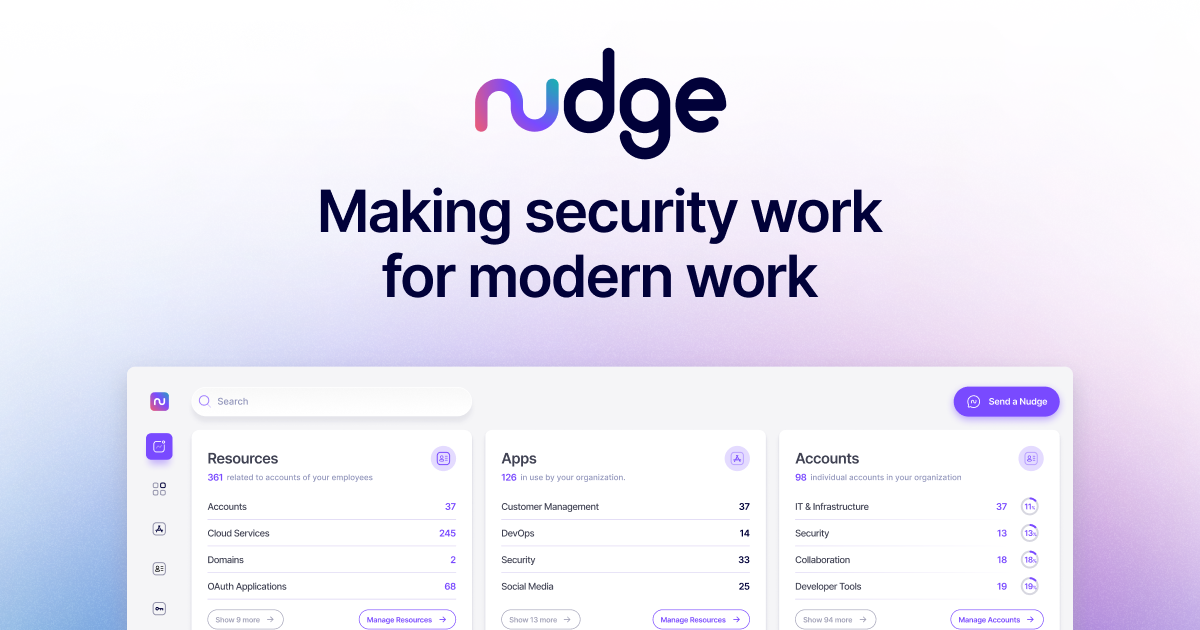
Nudge Security pioneered the email-signal-mining approach to shadow IT discovery and remains one of the most widely cited tools in the category. It correlates new SaaS accounts created with corporate email addresses, then “nudges” the employee who created the account with a workflow asking whether the tool is still needed and whether it should be reviewed by IT.
Key Features
- Discovery via email signals plus OAuth grant analysis across Google Workspace and Microsoft 365
- Automated nudges to employees who introduced shadow IT
- App risk scoring with vendor security posture information (SOC 2, breach history, data residency)
- OAuth grant inventory with one-click revocation in Google Workspace
Pros
- Strong organic content and a clear point of view on the category
- Lightweight deployment — no endpoint agent required
- Good UX for the “discover, then ask the employee” remediation pattern
Cons
- Coverage of non-human identities and AI agents is less developed than identity-first platforms
- Email-signal discovery misses apps that don't send welcome or notification emails
Ideal for: Mid-market organizations on Google Workspace or Microsoft 365 that want to operationalize shadow IT cleanup without rolling out endpoint software.
Reco: Shadow IT and Shadow AI with SSPM
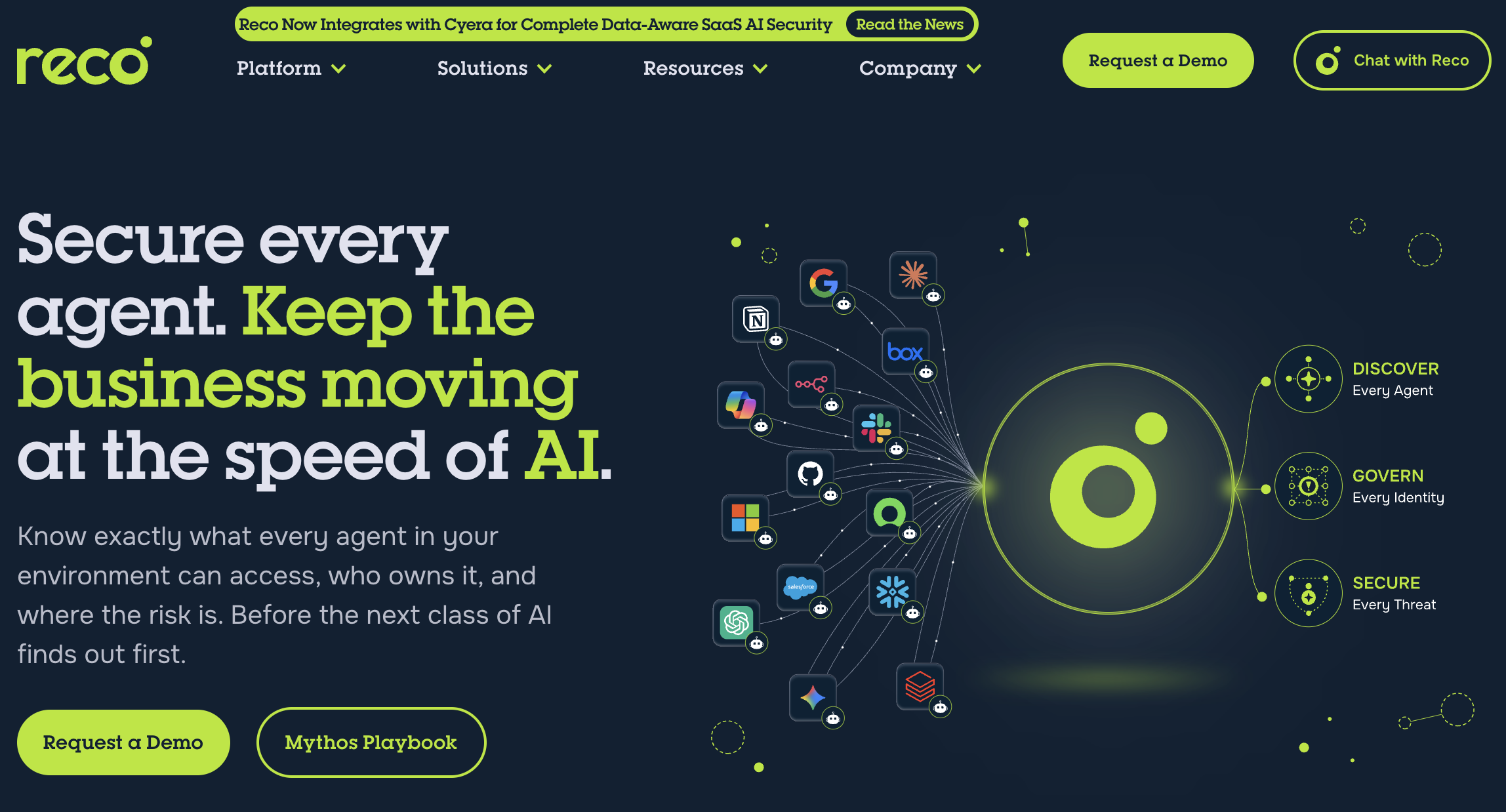
Reco positions itself at the intersection of SaaS security posture management (SSPM) and shadow IT/AI detection. The platform connects to a long list of SaaS apps via API and identifies risky configurations, exposed data, and unsanctioned applications, including AI tools and copilots.
Key Features
- Shadow AI detection covering browser-based AI tools, OAuth-connected agents, and copilots
- SSPM-style configuration checks across major SaaS apps (Salesforce, Microsoft 365, Google Workspace, Slack, GitHub)
- Identity-graph analysis linking users, apps, OAuth grants, and shared resources
- Risk scoring tuned for AI-specific scopes such as Gmail read, Drive read, and meeting transcript access
Pros
- Among the strongest shadow AI detection capabilities in the category in 2026
- Broad SaaS integration coverage
- Useful for security teams that also want SSPM in the same platform
Cons
- Enterprise-leaning pricing and onboarding; less suitable for small IT teams
- Overlap with existing SSPM investments can create tool sprawl
Ideal for: Security teams at mid-market and enterprise organizations that want a single platform for SSPM and shadow IT/AI detection.
BetterCloud: SaaS Management with Workflow Automation
BetterCloud is one of the longest-running SaaS management platforms and offers shadow IT discovery as part of a broader suite covering license optimization, lifecycle automation, and policy enforcement. Its strength is the depth of its automated remediation workflows.
Key Features
- SaaS discovery via OAuth, SSO, browser extension, and finance integrations
- Workflow engine for offboarding, license reclamation, and policy enforcement
- Granular per-app policy templates
- Reporting and audit logs aligned with SOC 2 and ISO 27001
Pros
- Deep workflow automation — among the best in the category for “discover then act”
- Mature reporting suitable for compliance evidence
- Wide integration catalog
Cons
- Implementation is heavier than newer cloud-native tools; expect weeks rather than minutes
- Total cost of ownership is on the higher end of the category
Ideal for: IT operations teams at organizations that already use a SaaS management platform and want to consolidate shadow IT discovery into the same surface.
Stitchflow: Free OAuth-First Shadow IT Scanner
Stitchflow has gained attention with a free shadow IT scanner that connects to Google Workspace or Microsoft 365 and produces a ranked inventory of OAuth-connected apps and the users who consented to each. The paid tier adds continuous monitoring and remediation workflows.
Key Features
- Free scanner that produces a one-time shadow IT inventory in minutes
- OAuth scope-based risk scoring per app and per employee
- Alerts when new or high-risk apps appear
- Browser extension available for deeper SaaS discovery
Pros
- The free scanner is a strong starting point for any IT team that simply wants to see what's connected
- Quick deployment, no professional services required
- Clear OAuth-centric point of view
Cons
- Remediation workflows are less mature than larger SaaS management platforms
- Non-human identity and AI agent coverage is limited compared with identity-first platforms
Ideal for: Smaller IT and security teams that want a low-friction way to baseline their shadow IT exposure.
Zylo: SaaS Management with Financial Discovery
Zylo is a SaaS management platform with a strong emphasis on financial discovery and license rationalization. Its shadow IT detection comes primarily from parsing corporate card and expense system data, which catches paid SaaS subscriptions that bypass procurement.
Key Features
- Financial discovery via integrations with major expense systems and ERPs
- SaaS inventory with contract, renewal, and spend data alongside usage
- License optimization recommendations
- Vendor risk and compliance metadata
Pros
- Strongest financial-discovery angle in the category — useful for finance-led SaaS programs
- Helpful for joint security-and-finance teams negotiating consolidation
- Mature contract management features
Cons
- Free tools, OAuth-only apps, and AI agents bought with personal funds are not visible without supplementary discovery
- Better fit for SaaS portfolio management than for security-first detection
Ideal for: Organizations where IT, finance, and procurement jointly own the SaaS portfolio and want shadow spend in the same view as shadow IT.
Productiv: SaaS Intelligence and Engagement Analytics
Productiv is a SaaS intelligence platform focused on application usage, engagement, and adoption. It detects shadow IT by ingesting SSO logs, OAuth grant data, finance feeds, and a browser extension, then correlating into a unified application inventory.
Key Features
- Multi-source SaaS discovery (SSO, OAuth, finance, browser)
- Engagement and adoption analytics per application and team
- Application portfolio rationalization recommendations
- Integrations with major IdPs and HRIS platforms
Pros
- Strong analytics layer — useful when you need to make the business case for cutting underused SaaS
- Broad data sources reduce blind spots
- Engagement metrics help separate critical apps from incidental ones
Cons
- Less focused on OAuth and AI agent risk than identity-first platforms
- Browser extension rollout is required for full visibility, which adds deployment work
Ideal for: IT portfolio managers and CIO offices that want shadow IT discovery alongside usage analytics for the whole SaaS estate.
Auvik SaaS Management: Network DNA, Cloud Reach
Auvik is best known for network monitoring, and its SaaS management module extends that DNA into the cloud. The platform discovers SaaS apps through SSO, OAuth, and email-signal mining, then tracks usage and license assignment over time.
Key Features
- Multi-signal SaaS discovery covering OAuth, SSO, and email cues
- License optimization across Google Workspace, Microsoft 365, and major SaaS apps
- Continuous monitoring for new accounts and apps
- Reporting for IT operations and audit
Pros
- Good fit for IT teams that already use Auvik for network visibility
- Clean UI and quick onboarding
- Reasonable pricing for mid-market organizations
Cons
- Security and OAuth-risk capabilities are less developed than dedicated security tools
- Limited shadow AI specialization
Ideal for: Mid-market IT teams looking for SaaS discovery alongside their existing network monitoring stack.
Netskope: Enterprise CASB with Network-Based Discovery
Netskope is a major Secure Access Service Edge (SASE) and Cloud Access Security Broker (CASB) vendor whose cloud catalog includes 65,000+ apps. Its shadow IT detection runs on network traffic inspection across managed devices, surfacing access to unsanctioned applications in real time.
Key Features
- Real-time network-traffic-based discovery across managed devices
- One of the largest cloud app catalogs in the industry
- Inline policy enforcement, DLP, and threat protection in the same platform
- Integration with major IdPs and SIEMs
Pros
- Enterprise-grade coverage and inline enforcement
- Mature integrations and a large partner ecosystem
- Strong DLP capabilities tied to discovery
Cons
- Requires SASE-class deployment, which is a multi-quarter project for most organizations
- OAuth grant visibility is weaker than identity-first tools because the discovery signal is network, not identity
- High total cost of ownership
Ideal for: Large enterprises that have already committed to a SASE or CASB architecture and want shadow IT detection as part of that platform.
Axonius: Cyber Asset Management
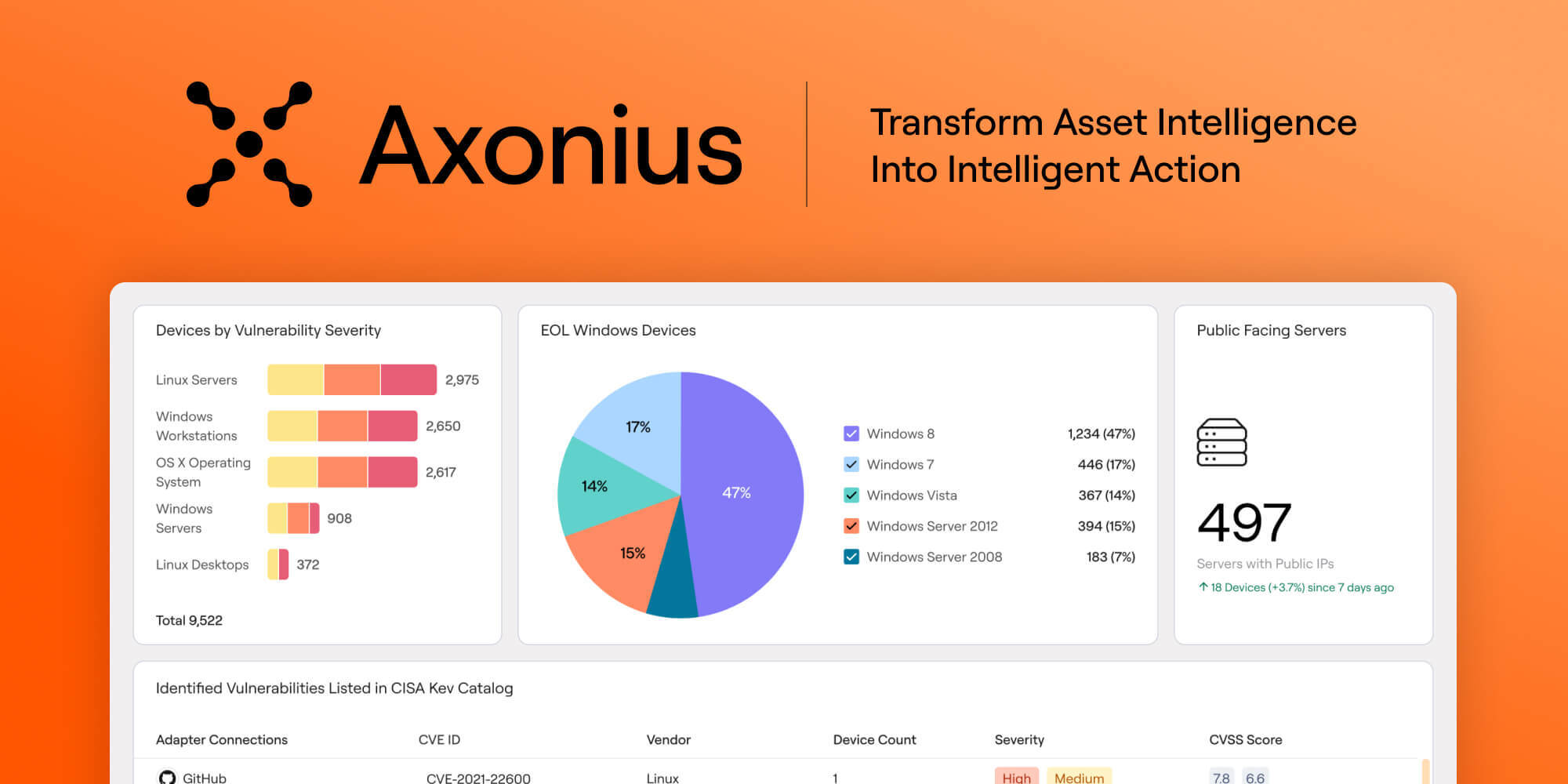
Axonius is a cybersecurity asset management platform that aggregates data from hundreds of sources — endpoint, identity, cloud, SaaS, and security tools — into a unified inventory of every device, user, and asset. Shadow IT detection is one use case within that broader inventory.
Key Features
- Aggregation across 800+ data sources covering devices, identities, cloud, and SaaS
- Unified asset inventory with policy-driven gap detection
- Strong integration with security tooling (SIEM, EDR, vulnerability management)
- Custom queries and dashboards for security operations
Pros
- Best-in-class breadth — useful when shadow IT detection is one piece of a larger asset management problem
- Strong fit for mature SOCs
- Powerful query language for custom reporting
Cons
- Heavier deployment effort than purpose-built shadow IT tools
- Cost and complexity make it overkill for organizations that only want SaaS discovery
Ideal for: Mature security organizations that want shadow IT detection as part of a unified cyber asset attack surface management (CAASM) program.
How to Choose the Right Shadow IT Detection Tool
The right shadow IT detection tool depends on what kind of organization you're protecting and what you're going to do with the findings. Six questions help narrow the field:
- What is your identity provider? If you are primarily on Google Workspace or Microsoft Entra ID, identity-first tools that read directly from the IdP will produce a more accurate OAuth inventory than network-based tools.
- How fast do you need to act? If you have a board meeting next month and need a baseline today, prefer tools with a free or low-friction scanner. Multi-quarter SASE rollouts are not the right answer to “what's connected to our tenant right now.”
- Who owns remediation? If IT operations does the cleanup, prefer platforms with mature workflow engines. If security owns it, prefer identity-graph platforms with revocation built in.
- What about shadow AI? If AI tooling is your top concern, prioritize platforms that explicitly model AI agents and OAuth scopes — most legacy CASBs and SaaS management platforms do not.
- Is finance part of the conversation? If you need to consolidate shadow spend, financial-discovery-first platforms are the strongest fit; identity-first platforms typically integrate spend later.
- What's the total cost of ownership? Per-employee pricing, no professional services, and no endpoint agent typically beats per-app pricing plus an SOW for organizations under 5,000 employees.
Shadow IT Detection Best Practices
A detection tool is necessary but not sufficient. The teams that get shadow IT under control follow a small set of recurring practices:
- Run a quarterly OAuth audit. At minimum every ninety days, review every third-party OAuth grant in Google Workspace and Microsoft Entra ID. Revoke anything dormant, unused, or with excessive scope.
- Make new-app review part of onboarding. Train new hires that connecting a new tool to corporate accounts is a five-minute conversation with IT, not a forbidden act.
- Treat OAuth revocation as an offboarding step. When an employee leaves, revoke every OAuth grant they created — not just their Google or Microsoft account.
- Set scope policies, not app policies. “Any app requesting Gmail read or Drive read scopes must be reviewed” scales better than maintaining an allow-list of approved apps.
- Include AI tools in your data-handling policy. Make it explicit which AI tools may handle customer data, which may not, and how to request a new one.
- Use the discovery report as a procurement input. Most shadow IT is not malicious; it's an employee solving a real problem with the fastest tool available. Use the discovery report to fund the official versions of the tools your employees clearly need.
Final Thoughts
Shadow IT was a procurement annoyance in 2018. In 2026 it is the most direct path an attacker has into your SaaS estate, and the most overlooked source of compliance exposure. The good news is that the detection problem is solvable in an afternoon, not a quarter — provided you start from identity and OAuth rather than the network.
If your stack runs on Google Workspace or Microsoft Entra ID, the fastest way to see what you're exposed to is to run the free Synk.to scanner. Five minutes, no credit card, and a complete inventory of every OAuth-connected app, user, and scope — including the AI agents.
FAQs
What is shadow IT?
Shadow IT is any application, OAuth grant, AI tool, or SaaS account that touches company data without explicit IT or security approval. Common examples include unsanctioned productivity tools, OAuth-connected third-party apps, browser-based AI assistants, and personal accounts handling work data.
How does a shadow IT detection tool work?
Shadow IT detection tools combine multiple discovery signals — OAuth grants from the identity provider, SSO logs, browser activity, network traffic, financial data, and email cues — to build a single inventory of every application connected to your environment. The most effective tools blend at least three of these signals.
What's the difference between shadow IT and shadow AI?
Shadow AI is a subset of shadow IT specifically covering AI tools and agents — copilots, browser-based AI assistants, OAuth-connected agents, and LLM-powered automations. The risk profile is different because AI tools often request broad read scopes (Gmail, Drive, transcripts) and exfiltrate data to third-party model providers.
Is OAuth the main shadow IT risk in 2026?
For most cloud-first organizations, yes. OAuth grants bypass MFA, do not expire, and are invisible to most SIEMs and CASBs. A single malicious or over-permissioned OAuth app can read every message, file, or calendar entry in a tenant. Network-traffic-based detection misses OAuth entirely.
Can I detect shadow IT for free?
Yes. Several platforms, including Synk.to, AccessOwl, and Stitchflow, offer free shadow IT and OAuth scanners that connect to Google Workspace or Microsoft Entra ID via OAuth and produce a one-time inventory. These free tools are an effective baseline before committing to a paid platform.
How long does deployment take?
Modern, identity-first platforms deploy in minutes via OAuth — no endpoint agent, no professional services. Older CASBs and enterprise SaaS management platforms can take weeks to months depending on integration scope and policy configuration.
Do shadow IT detection tools replace a CASB?
For most cloud-first organizations on Google Workspace or Microsoft Entra ID, the answer is increasingly yes. CASBs were designed for the network era and see traffic, not identity. Identity-first detection tools see OAuth grants, scopes, and users — which is where the actual risk lives in a 2026 SaaS stack.
How does Synk.to detect shadow IT and OAuth apps?
Synk.to connects to Google Workspace or Microsoft Entra ID via OAuth in under five minutes and produces a complete inventory of every third-party app, the users who consented, the scopes granted, and a risk score per app. The free scanner requires no credit card. Paid tiers add continuous monitoring, automated user access reviews, and identity sync across the rest of your SaaS stack.