AI Agent Identity Management: What It Is and Why It Matters in 2026
Learn what AI agent identity management is, why it matters in 2026, and how Synk.to gives you control. Learn more details and solutions here.

AI agents are incredibly popular in 2026. They are everywhere, from code generation, incident response, customer operations, workflow automation, and even internal support systems. But who’s monitoring them?
In more cases than the modern enterprise industry would like to admit, AI agents run free and wild without clear ownership, governance, or even lifecycle controls. What does this lead to? Jeopardized systems security, permission misuse, and all the other risks that were previously only associated with employees and service accounts.
Traditional identity and access management (IAM) systems were built for employees and service accounts. This is why autonomous AI entities that create actions, access data, and interact across multiple SaaS environments are a bit out of scope for traditional systems. So, to keep up with the times, traditional systems are upgrading, led by enterprises that are adopting more AI-driven workflows.
This article explores what AI agent identity management is, why conventional IAM models are not equipped to manage it, and what a secure lifecycle should look like. We’ll also explore how Synk.to, helps organizations manage AI agent identities across Google and Microsoft Entra ID Workspace environments.
What Is AI Agent Identity Management?
AI agents are autonomous non-human identities (NHIs) that have now become a part of the workforce alongside human counterparts. AI agent identity management revolves around assigning, governing, monitoring, and revoking access for AI agents, the same way it would be done for a human employee.
The primary goal of AI agent identity management is to control what the agent can access, the actions it can perform, and the behavior that is going to be monitored long-term.
The problem with AI agent identity management lies with the fact that many IT teams still classify them as service accounts. But AI agents are not service accounts, even though they don’t also classify as a human employee, AI agents can still autonomously make decisions, interact with multiple systems, generate code, analyze data, and trigger actions dynamically based on context.
These specifications clearly differentiate AI agents from service accounts and teams that fail to understand the context; these are mainly the ones struggling with AI agent identity management.
Without adequate security measures, when AI agents run free, they can behave unpredictably and expose sensitive data if compromised. So, without adequate IAM measures, the security risk posed by AI agents is far greater and can span entire workflows and SaaS environments.
Platforms like Synk are designed to address this very challenge. It detects, controls, and shadows AI agents, risky OAuth apps and SaaS integrations, over-permissive OAuth scopes, and orphaned access across Microsoft Entra ID and Google Workspace environments.
Why Is AI Agent Identity Lifecycle Management Solutions a Priority in 2026?
The main reason AI agent lifecycle management is becoming a priority in 2026 is that enterprises are scaling autonomous AI faster than their governance models. Research and advisory firms like Gartner have predicted that by 2036, 30% of enterprises will rely on AI agents capable of independently triggering transactions and completing tasks on behalf of humans. To put that into perspective, the global workforce is around 3.7 billion workers in 2026. Even 30% of that is over a billion AI agents that could potentially be working without oversight.
The problem that’s glaring in this situation is the use of management techniques to bypass the infrastructural development required to adequately govern AI systems at scale. The model that’s currently being used is fragmented ownership. This model makes it so that the AI agents and NHIs can be created and managed by development teams while security and identity governance teams remain focused on human users.
Now, this situation begs the question, why don’t governance teams also take responsibility for AI and NHI governance? The very simple and almost stupid answer is that development and governance teams don’t play well together. In a recent study conducted by IBM, nearly three-quarters of respondents said platform and development teams do not collaborate effectively with security teams.
So, what are the security risks of I don’t like you? Here’s a brief overview:
- Credential Sprawl: Legacy NHI models relied on static and long-lived credentials. AI agent identities are significantly more dynamic. AI agents can reason, delegate, and interact across multiple systems. Traditional identity models were never designed to manage these systems infrastructurally.
- Orphaned Access: In many cases, AI agents are created for experimental projects, but they are never officially deprovisioned. As a result of that, these agents leave access paths inside enterprise environments. Platforms like Synk help identify these orphaned AI agents in real time inside Google Workspace and Microsoft Entra ID environments.
- Shadow AI and Risky OAuth Applications: As employees increasingly adopt AI-powered tools and autonomous agents without IT approval, organizations face a growing shadow AI problem. Many of these applications gain access through OAuth and are granted permissions directly by end users, bypassing traditional security reviews. This creates blind spots for security and identity teams, making it difficult to assess vendor trustworthiness, monitor data access, and prevent unauthorized exposure of sensitive corporate information.
- Over-permissive OAuth scopes: Due to the multi-system behavior of AI agents, they are often granted broad OAuth permissions during setup. These permissions are retained long after the original use case disappears. As a result, you have unnecessary exposure of sensitive business data if these agents are compromised.
- Prompt injection and identity spoofing: Security researchers have already documented cases involving identity spoofing, credential leakage through prompts, and LLM jailbreaks that manipulate AI agents into performing unauthorized actions. These threats pose a serious risk of exposing protected information.
The AI Agent Identity Lifecycle: What It Should Look Like
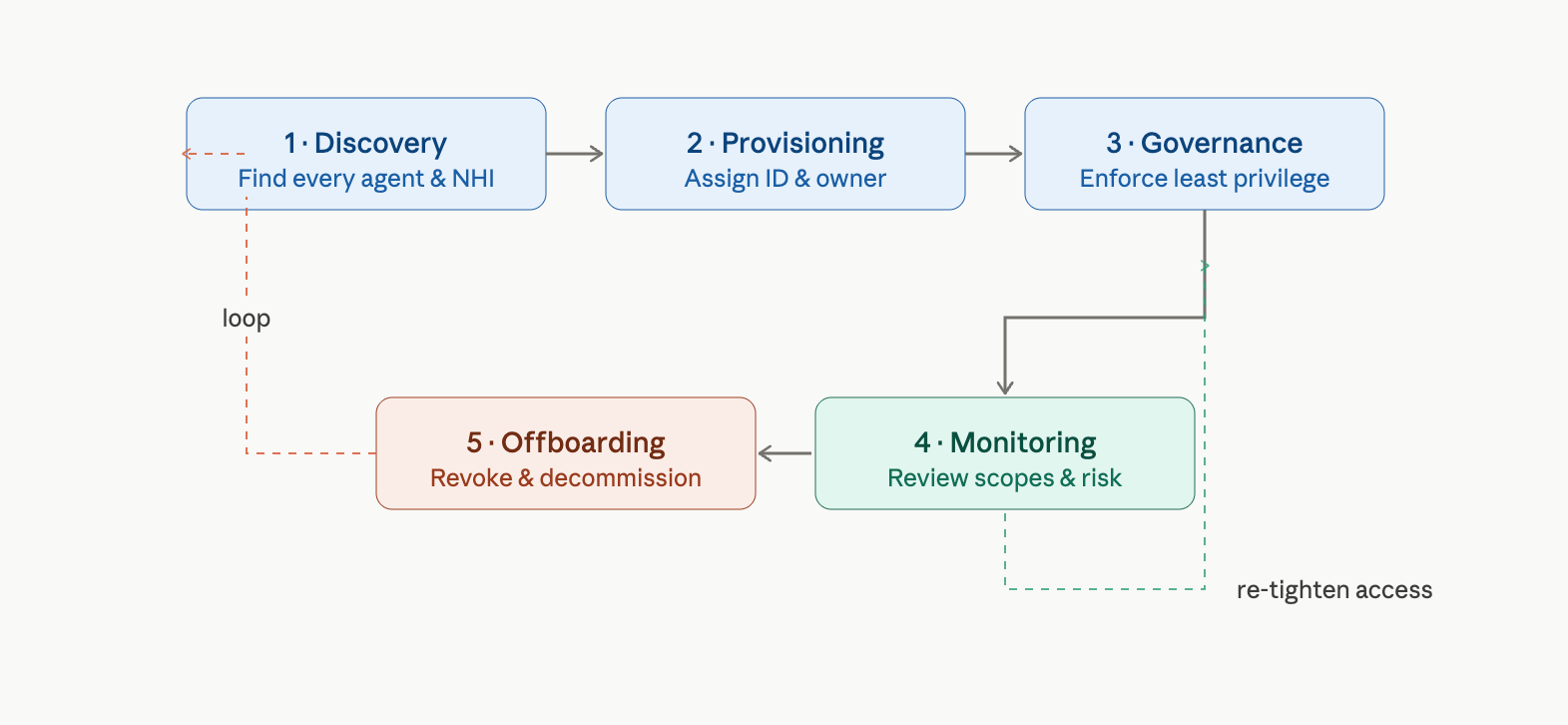
If you are running AI agents at scale, this section specifically is for you. We will go into the details of what an AI agent identity lifecycle management solution should ideally look like. It is not just about identifying risky agents after deployment. We will also go into a full governance model that can discover, provision, monitor, and eventually retire AI agents as per security requirements. This structure is how mature AI agent identity management should look like in practice.
1. Discovery: Identifying All NHIs
Do you know how many AI agents your enterprise is running on if your agents can create more sub-agents? This is exactly why modern IAM platforms like Synk run a continuous discovery of AI agents operating across systems, including SaaS-connected agents, internally developed workflow agents, and locally running resources such as MCP servers. Synk creates a clearly labeled, governed inventory of all such identities with clear metadata and ownership records. The platform also shadows AI activity and SaaS integrations across Google Workspace and Microsoft Entra ID environments. This monitoring even includes agents your IT teams may not even know exist.
2. Registration & Provisioning: Giving NHIs Identities
Now that you have identified the number of NHIs you’re dealing with at your organization, let’s give them all IDs. No, not name IDs, but rather a distinct metadata for each agent that has the following information:
- Purpose of the agent
- Scoped permissions of the agent
- At least one human owner of the agent
This method creates traceability and accountability in the system. It also ensures AI agents remain anchored within existing organizational governance structures. Lastly, this system also ensures that the foundations of accurate access reviews are laid, even for NHIs to enforce lifecycle governance.
3. Access Governance: Enforcing Least Privilege Principles
At this stage, you have already identified all the agents you’re running, and you have given them IDs to track and monitor their actions. Now comes the part for which IT teams and security teams don’t like each other: least privilege principles. As per these principles, AI agents should always operate under least-privilege principles. This means no long-lived credentials and no standing privileges.
Instead, the least privilege principle requires organizations to move to a just-in-time access model. This model is supported by automated lifecycle management, the likes of which are offered by Synk. It helps automate SaaS access control and keeps permissions continuously aligned with user roles and policies without relying on manual review cycles.
4. Continuous Monitoring & Review: Automation At Its Best
To enforce the least privilege principles, you need continuous monitoring and automation systems. Synk has access review capabilities that help identify the following:
- Over-permissive OAuth scopes
- High-risk SaaS and OAuth integrations
- Excessive privileges
Platforms like Synk.to ensure that these threats can be identified and neutralized before they can turn into security incidents.
5. Revocation & Offboarding: Mature Lifecycle Management
To prevent situations where unused or old AI agents can be exploited, there needs to be a system in place that revokes the permissions and offboards an AI agent when it is no longer needed. This includes decommissioning its ID and all the access it held.
This is the last and final step of a mature lifecycle management process, and it eliminates risks such as orphaned credentials, unused OAuth grants, and permission sprawl. Synk specifically helps with end-to-end lifecycle automation from initial provisioning through final access revocation. This helps organizations maintain continuous control over AI agent identities.
How Synk.to Handles AI Agent Identity Management
Now that you know how the workflow should be ideally. Here’s how Synk can help. For starters, Synk is a cloud-first identity governance platform that’s built to help organizations discover, govern, and automate access for AI agents, non-human identities (NHIs), and SaaS applications.
It functions across the Google Workspace and Microsoft Entra ID environments. Contrary to traditional IAM systems, Synk provides centralized visibility and lifecycle control designed specifically for modern SaaS ecosystems, instead of treating AI agents as unmanaged service accounts.
The platform focuses on four core capabilities that address AI agent identity risks directly, this includes:
- Malicious OAuth Apps and Shadow AI Detection: Synk.to continuously monitors and discovers AI agents and SaaS integrations that employees authorize. This is made possible by the systems inventory that Synk.to maintains. It provides real-time visibility into everything connected to your environment. It helps security teams uncover shadow AI before it becomes a governance problem.
- Non-human Identity Management: With Synk.to, service bots, automation agents, and AI-driven integration, is continuously discovered, monitored, and governed. One of the top benefits of Synk.to is that, unlike traditional IAM environments, it extends its management natively to AI agent identities, reducing system blind spots.
- Access Control and Permission Review: When you’re dealing with multiple agents and handling their permissions, discovery, and access governance, a single actionable dashboard can be of great help, and that’s exactly what Synk.to provides. It keeps permissions aligned with organizational roles automatically, while over-permissive OAuth scopes and risky integrations are surfaced on the dashboard.
- Automated Provisioning and Deprovisioning: Organizations can provision a user or AI agent identity in one SaaS platform and synchronize access changes across connected systems in real time. Synk.to helps in this regard by removing access across all linked environments simultaneously to prevent orphaned permissions after an agent is decommissioned.
FAQs
1. What is the difference between AI agent identity management and traditional IAM?
Traditional IAM was designed for predictable machine accounts. Comparatively, AI agent identity management deals with managing autonomous accounts that can make decisions, interact with multiple systems, generate code or content, and trigger actions dynamically. This is why AI agent identity management requires continuous monitoring, lifecycle governance, and scoped permissions. It also needs stronger controls around OAuth access, ownership, and behavioral risk.
2. What is a non-human identity (NHI)?
An NHI is any digital identity that’s not directly tied to any human user. NHIs include service accounts, bots, APIs, automation workflows, SaaS integrations, machine credentials, and AI agents. These identities are commonly used to process and enable system-to-system communication. However, unmanaged NHIs often create major security blind spots. This is because NHIs can retain persistent access across enterprise environments.
3. How does Synk.to detect shadow AI agents and malicious OAuth apps?
The secret to detecting shadow AI agents lies in continuous monitoring, and that’s exactly what Synk does. It scans connected Google Workspace and Microsoft Entra ID environments. This helps Synk identify AI agents, SaaS integrations, OAuth connections, and non-human identities. The tricky part is that Synk identifies these identities that may have been created without IT approval. This means not only is it helping enterprise systems protect from security risks, but it is also identifying shadow AI agents that do not hold proper IDs and over-permissive OAuth scopes. And the best part? Synk.to offers all of this from a centralized dashboard.
4. How long does Synk.to take to set up?
Synk.to is designed for fast deployment. It requires very little setup time, as it is a system that’s built on read-only access to begin discovery. So, in most cases, enterprises can start identifying risky AI agent permissions, shadow integrations, and access governance issues in under five minutes. This is one of the best features of Synk, as it does not require complex implementation and long onboarding cycles.