SailPoint vs Saviynt vs Okta vs Entra ID: Pricing Compared
We compared SailPoint, Saviynt, Okta Identity Governance, and Microsoft Entra ID Governance on real 2026 pricing, implementation time, and fit.

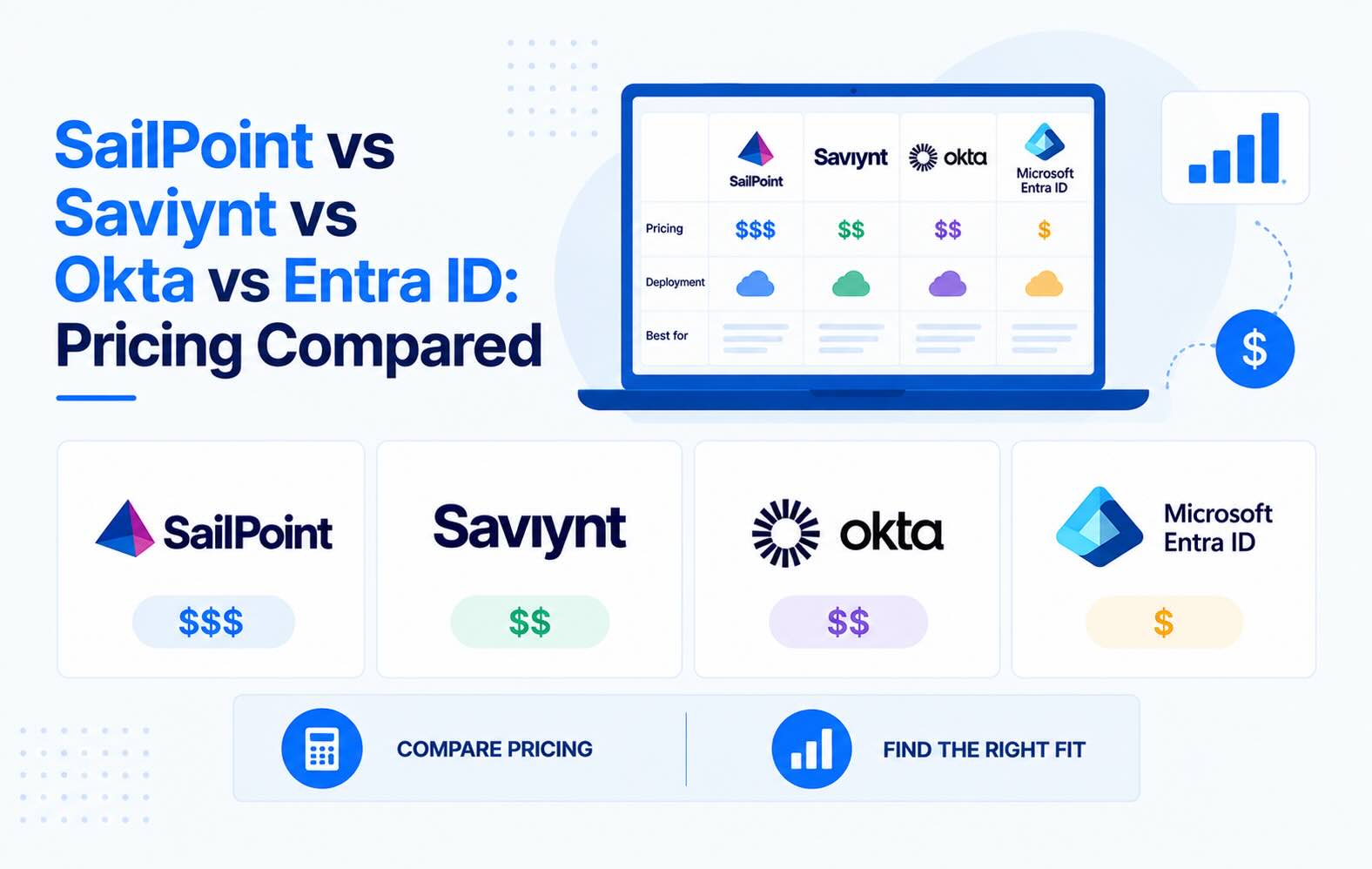
SailPoint, Saviynt, Okta, and Microsoft all sell "identity governance" — but they price it differently, implement on wildly different timelines, and none of them actually cover the same ground. Here's what each one costs, how long each one takes to stand up, and which one (if any) actually fits your stack.
- SailPoint and Saviynt are quote-only enterprise platforms built for 2,000-5,000+ employee organizations, with 6-18 month implementations and Year 1 costs (software plus professional services) that commonly land between $360K and $1M.
- Okta Identity Governance and Microsoft Entra ID Governance are both add-ons to a platform you may already own — Okta at roughly $9-11/user/month on top of Workforce Identity Cloud, Microsoft at $7/user/month on top of an Entra ID P1 or P2 base you're required to already hold.
- Okta's governance automation only works for SCIM-connected apps, and industry estimates put 75-85% of a typical company's app stack outside SCIM coverage — meaning the fastest-to-deploy option also covers the least of what you actually use.
- All four platforms share the same blind spot: they discover access through SSO or SCIM, which means OAuth-connected apps, shadow IT, and non-human identities that never touch that layer stay invisible to all of them.
- Synk.to isn't a fifth entry in this same category — it's a lightweight layer that starts with discovery instead of assuming it, at $1/user/month with a 14-day free trial and no professional services engagement.
Quick Comparison: What Each One Actually Costs
SailPoint (IdentityNow/IdentityIQ): No public pricing. Quote-based, per-identity/year. One documented example: a 5,000-identity Business-tier deal at $6-9/identity/month ($360K-$540K/year in license alone). Independent benchmarks put the median annual license around $113K, with a $22K-$528K range depending on scale and modules, and total Year 1 cost (license plus implementation) commonly $360K-$1M for a 5,000-employee deployment.
Saviynt: Also quote-only, and the public data on it is genuinely inconsistent — one buyer benchmark called it "significantly more expensive" than comparable platforms, while a separate case study cited $24/user/year for a 5,000-seat deal. Treat any number you see, including this one, as a starting point for negotiation, not a benchmark.
Okta Identity Governance: Priced as an add-on at roughly $9-11/user/month on top of Workforce Identity Cloud licensing (estimates as low as $4/user/month appear in some sources, depending on bundle). A realistic full stack — SSO, adaptive MFA, lifecycle management, and governance together — lands most organizations at $18-25/user/month once every add-on is layered in.
Microsoft Entra ID Governance: Sold as a $7/user/month add-on, but it requires an Entra ID P1 ($7/user/month) or P2 ($10/user/month) base subscription you may already hold as part of Microsoft 365. Effective all-in cost for governance alone is roughly $14-17/user/month. Microsoft's broader Entra Suite bundles governance with four other products for $12/user/month on top of P1 — cheaper per-product, but only if you actually want all five.
SailPoint: The Market Incumbent
SailPoint is the default answer for large, regulated enterprises with SAP or Oracle-centric access models and a multi-year budget to match. It has the deepest connector ecosystem of the four (independent estimates put it at 800-1,000+ connectors) and the most mature SoD and role-mining tooling for ERP environments.
The tradeoff is time and cost: implementations commonly run 6-18 months to full maturity, and professional services typically account for more of the total spend than the license itself. This is a platform you commit to, not one you pilot.
Saviynt: The Cloud-Native Challenger
Saviynt targets the same enterprise buyer as SailPoint — 2,000+ employees, complex entitlement models — but converges IGA with cloud privileged access management (PAM) in a single control plane, something SailPoint only offers via an acquired, separate product. Its cloud-native architecture deploys somewhat faster than SailPoint's, though "faster" here still means months, not weeks, and ongoing configuration changes typically require continued professional services engagement.
Okta Identity Governance: Fast, If Your Stack Is SCIM-Friendly
Okta Identity Governance is the fastest of the four to show value — implementation for SCIM-connected apps can genuinely happen in weeks, not months, if you're already running Okta as your identity provider. The catch is scope: OIG's automated provisioning and deprovisioning only works for apps that speak SCIM. Non-SCIM apps require custom API integration work per app, and with an estimated 75-85% of a typical SaaS stack lacking SCIM support, that's most of what you actually run.
Microsoft Entra ID Governance: The Bundled Option
For organizations already standardized on Microsoft 365 and paying for Entra ID P1 or P2, Entra ID Governance is the path of least resistance — Lifecycle Workflows, access reviews, and entitlement management extend a subscription you're likely already carrying, rather than introducing a new vendor relationship. The dependency runs the other way for everyone else: you can't buy governance alone, and the value case weakens quickly for organizations that aren't already deep in the Microsoft ecosystem.
The Gap All Four Share
Every platform above discovers access the same way: through SSO or SCIM. That's a real strength for the applications wired into that layer, and a real blind spot for everything that isn't. OAuth-connected apps a user authorized directly with "Sign in with Google" or "Sign in with Microsoft," shadow IT tools nobody provisioned through the identity provider, and non-human identities like service accounts and AI agents all sit outside SSO by design — which means they sit outside governance for SailPoint, Saviynt, Okta, and Microsoft alike.
These platforms were also built for human users on scheduled review cycles — quarterly or annual access certifications — not for the volume and churn of machine identities and AI agents that now make up a growing share of access in most environments.
How to Get an Accurate Quote
Since none of the four publish real pricing, a few questions separate a usable quote from a sticker-shock surprise:
- Ask for the Year 1 total, not the license line. Professional services are frequently the larger number, not the smaller one.
- Ask what's out of scope by default. Non-SCIM apps, custom connectors, and non-human identities are the categories most likely to require a separate statement of work.
- Ask what the renewal price does. Year 1 often includes one-time implementation discounts that don't repeat in Year 2 and beyond.
- Ask for a reference customer at your size and industry — pricing structures on these platforms vary enough by deal that a same-size peer's experience is more useful than the vendor's list price.
Where Synk.to Fits
None of the four platforms above are wrong choices for what they're built to do — enterprise-grade governance over human identities across a well-inventoried, SSO-connected app estate. But that's a different problem than knowing which OAuth-connected apps, shadow SaaS tools, and AI agents are quietly holding access to company data right now, today, without a multi-quarter implementation.
Synk.to starts with discovery — connecting to Google Workspace or Microsoft Entra ID with read-only access and surfacing every OAuth grant, SaaS system, and non-human identity in minutes, each one scored against a database of 3,000+ vendors for compliance posture and risk. It's not a replacement for SailPoint or Saviynt if you're running SAP-scale entitlement governance. It's the layer that tells you what actually needs governing in the first place, at $1 per user per month with a 14-day free trial and no professional services engagement. Start free trial.
Final Thoughts
The four platforms compared here solve real problems at real cost — SailPoint and Saviynt for large, regulated enterprises; Okta and Microsoft for organizations extending a platform they already own. The number that matters most isn't the per-user rate any of them quote — it's the implementation timeline and the professional services line, since both routinely dwarf the license cost itself.
FAQs
Which is cheaper, SailPoint or Saviynt?
Neither publishes pricing, and the available data is inconsistent — one buyer benchmark calls Saviynt more expensive than comparable platforms, while a separate case study puts it well below typical SailPoint deal sizes. Get quotes for your specific scale before assuming either is cheaper.
How much does Okta Identity Governance cost?
Roughly $9-11/user/month as an add-on to Workforce Identity Cloud, though estimates as low as $4/user/month appear depending on bundling. A realistic full stack with SSO, MFA, lifecycle management, and governance together typically runs $18-25/user/month.
Do I need Entra ID P1 or P2 to get Microsoft Entra ID Governance?
Yes. Entra ID Governance is sold as a $7/user/month add-on, but it requires an existing Entra ID P1 ($7/user/month) or P2 ($10/user/month) base subscription — it cannot be purchased standalone.
Why do SailPoint and Saviynt take so long to implement?
Both require custom connector work, manual entitlement modeling for every governed application, and professional services to translate access policies into the platform's rule engine — typically a 6-18 month process for SailPoint and 6+ months for Saviynt, longer in complex environments.
Does Okta Identity Governance cover every app in my stack?
Only apps that support SCIM get automated provisioning and deprovisioning. Industry estimates suggest 75-85% of a typical company's app stack lacks SCIM support, leaving those applications outside automated governance regardless of which of these four platforms you choose.
What do all four platforms miss?
All four discover access through SSO or SCIM, so OAuth-connected apps, shadow IT, and non-human identities that never touch that layer stay invisible. All four were also built around human users on scheduled review cycles, not the volume of machine identities and AI agents now common in most environments.
How does Synk.to compare on price?
Synk.to is $1 per user per month with a 14-day free trial and no professional services engagement, positioned as a discovery layer for OAuth apps and non-human identities rather than a full enterprise IGA replacement for SailPoint- or Saviynt-scale deployments. Start free trial.