Identity Governance for Google Workspace: What It Doesn't Give You
Google Workspace gives you IDp foundation - but no native access certification, no OAuth risk scoring, and no visibility on vendor risk. Here's how to close the governance gap.

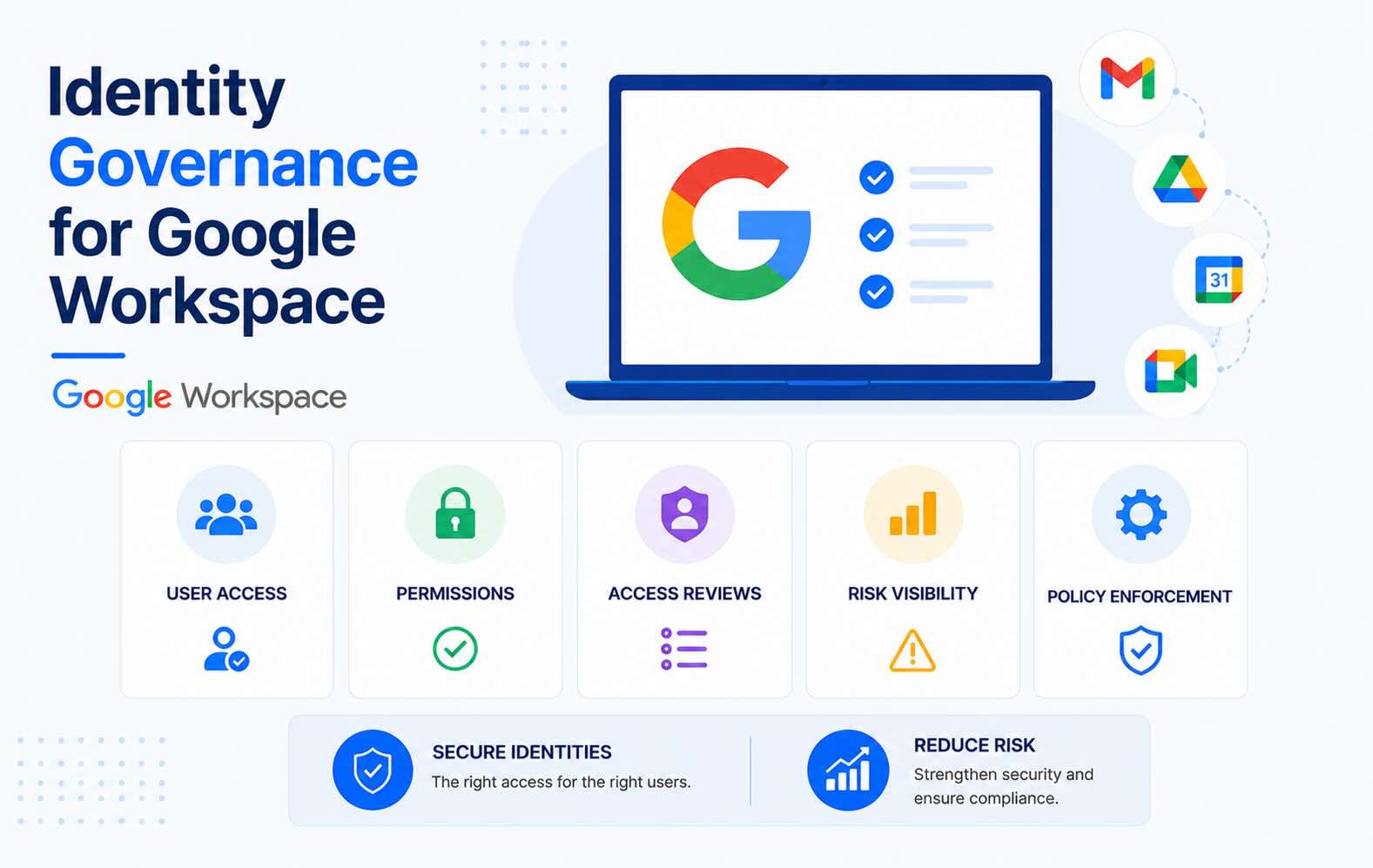
Google Workspace gives you a real identity foundation — directory, groups, org units, MFA enforcement, even Context-Aware Access on the Premium tier. What it doesn't give you is identity governance: no native way to periodically certify that access is still appropriate, no scoring of which connected apps belongs to risky low reputation vendors, and no visibility into what happens once a user's identity leaves Workspace and reaches the other 40+ SaaS tools they're actually using. Here's exactly where Google's own tooling stops, and what a governance layer on top of it actually needs to do.
- Google Workspace (and Cloud Identity Premium) covers real identity infrastructure — org units, groups, MFA, Context-Aware Access, admin audit logs — but has no native access-certification or periodic access-review feature, which is exactly why an entire ecosystem of third-party tools exists just to run Google Workspace access reviews.
- Unlike Microsoft, which now bundles governance features (Lifecycle Workflows, Access Reviews, Entitlement Management) into a paid Entra Suite add-on, Google doesn't sell an equivalent native governance bundle at all — the gap isn't a missing tier, it's a missing product category.
- Workspace governs Workspace. It has no visibility into what a user's identity does once they use it to authorize Slack, Jira, Zoom, or an AI meeting-note tool via OAuth — each of those is a separate identity boundary Workspace's own admin console can't see into.
- Org units and groups are a real governance foundation, not a substitute for governance — they control who gets what baseline access, not whether that access is still appropriate six months later.
- Synk.to is built specifically to close this gap for Google Workspace organizations: connect with read-only access, and get access reviews, OAuth risk scoring,Vendor risk scoring and cross-app identity governance in minutes, without waiting for Google to ship a feature it has no plans to build.
What Google Workspace Already Gives You
Before talking about the gap, it's worth being precise about what's genuinely solid here. Google Workspace's identity foundation is not weak — it's just scoped to authentication and directory structure, not governance:
- Organizational units (OUs) and groups. Every user sits in exactly one OU in a hierarchical tree, which determines baseline service and feature access; groups layer on top for more flexible, cross-cutting policy targeting without restructuring the org tree.
- MFA and Advanced Protection. Enforceable two-step verification and, for high-risk accounts, Google's Advanced Protection Program.
- App access control. Security → API controls lets admins see and restrict which third-party OAuth apps can access Workspace data, including trust-listing for high-risk scopes.
- Cloud Identity Premium adds real enterprise controls: Context-Aware Access (location- and device-state-based policies), advanced endpoint/device management, and a security center with audit logs.
- Admin audit logs give a record of admin actions — useful evidence, though it's a log, not a review workflow.
This is a legitimate, capable identity foundation. It's also, deliberately, not a governance product — and that's not a criticism of Google, it's a scoping decision that shows up clearly once you look at what's missing.
What Google Workspace Doesn't Do: The Governance Gap
Three gaps show up consistently once an org tries to actually govern access on Workspace, not just administer it:
- No native access certification. There's no built-in workflow for periodically asking "does this person still need this access?" and capturing the answer as evidence. This gap is well-established enough that a small industry of third-party Google Workspace access-review tools exists specifically to fill it — a real signal about what's missing natively, not a niche complaint.
- No visibility past Workspace's own boundary. Workspace authenticates logins and can see which third-party apps hold OAuth grants, but it has no concept of what happens inside Slack, Jira, Zoom, or an AI tool once that OAuth grant is issued — no scope-level risk scoring, no lifecycle sync so that a role change in Workspace propagates to those tools automatically.
- No non-human identity or AI agent governance. Service accounts, bots, and AI agents authorized via OAuth aren't treated as a distinct, reviewable identity class — they're either invisible or lumped in as generic "third-party apps" with no ownership or risk context attached.
Worth naming directly: Microsoft has partially closed this gap for its own ecosystem — Entra ID Governance (Lifecycle Workflows, Access Reviews, Entitlement Management) ships as a paid add-on, the Entra Suite, at roughly $12/user/month. Google has no equivalent native governance bundle on the roadmap. If you're on Google Workspace, this isn't a "wait for the next tier" problem — it's a category Google isn't building, which makes a third-party governance layer a structural requirement, not an optional upgrade.
Building Real Identity Governance on Top of Google Workspace
The right approach treats Workspace as the identity source of truth and layers governance on top of it, rather than trying to stretch OUs and groups into something they're not designed to be:
- Keep OUs and groups as the access-control foundation. They're the right tool for "what does this role get by default" — don't replace them, build on them.
- Add continuous OAuth and app discovery that goes beyond Workspace's own App access control list — full scope-level risk scoring for every connected app, including AI tools.
- Add structured, recurring access reviews that produce actual audit evidence (who reviewed what, when, and what they decided) rather than an ad hoc spreadsheet exercise every audit cycle.
- Sync identity lifecycle changes outward, not just within Workspace — a role change or offboarding event in Workspace should propagate to Slack, Jira, Zoom, and the rest of the connected stack automatically.
- Treat non-human identities as first-class — service accounts, bots, and AI agents reviewed with an owner and a risk score, not left outside the process entirely.
How Synk.to Delivers This for Google Workspace Teams
Synk.to is built specifically for this gap: it connects to Google Workspace with read-only access and, within minutes, produces a full inventory of every user, OAuth-connected app, AI agent, and non-human identity — with a risk score per app and scope, structured access reviews with a real audit trail, and automated provisioning/deprovisioning sync across the rest of your connected SaaS stack (Slack, Jira, Zoom, Asana, BambooHR, and more).
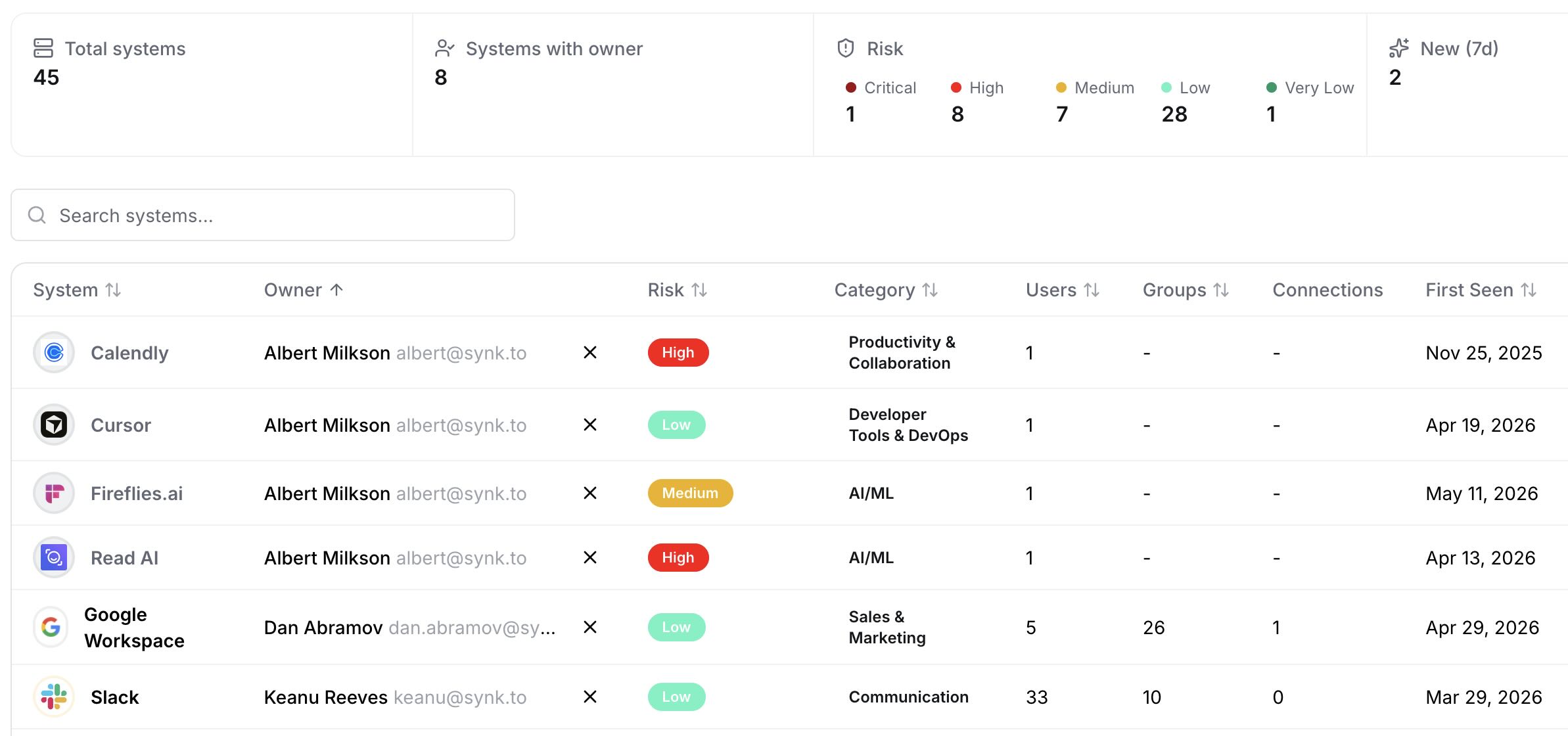
It's not a replacement for Google Workspace's own admin console — OUs, groups, and Cloud Identity Premium's Context-Aware Access remain the right tools for what they do. Synk.to is the layer that starts where those tools stop: the governance question of whether access is still appropriate, across every app your employees actually use, at $1 per user per month with no professional services engagement. Start free trial.
FAQs
Does Google Workspace have identity governance built in?
Not in the sense of access certification or periodic review. Google Workspace provides strong identity infrastructure — organizational units, groups, MFA, App access control for OAuth apps, and Cloud Identity Premium's Context-Aware Access — but no native workflow for periodically reviewing and certifying that existing access remains appropriate.
What is Cloud Identity Premium, and does it add governance features?
Cloud Identity Premium is Google's enterprise identity add-on, adding Context-Aware Access, advanced endpoint management, and a security center with audit logs. It strengthens authentication and device policy, but it doesn't add access certification, entitlement management, or cross-app lifecycle governance.
How is this different from Microsoft Entra ID Governance?
Microsoft sells a native governance add-on (the Entra Suite, including Lifecycle Workflows, Access Reviews, and Entitlement Management) for roughly $12/user/month. Google has no equivalent native governance product for Workspace — the gap has to be closed with a third-party layer regardless of budget tier.
Can I use organizational units and groups for access governance?
They're the right foundation for baseline access control — determining what a role gets by default — but they don't provide periodic review, audit evidence, or visibility into what happens once a user's Workspace identity authorizes third-party apps. Treat them as the access layer, not the governance layer.
Does Google Workspace show which third-party apps have OAuth access to company data?
Yes, via Security → API controls → App access control, which lists connected apps and lets admins restrict high-risk scopes. It's a real control, but it's a flat list without risk scoring, ownership assignment, or a recurring review workflow.
How does Synk.to add identity governance to Google Workspace?
Synk.to connects to Google Workspace with read-only access and delivers what the native admin console doesn't: OAuth risk scoring across every connected app and AI agent, structured access reviews with an audit trail, and lifecycle sync across your broader SaaS stack — for $1 per user per month, with visibility in minutes. Start free trial.